- survey of Mortimer Wheeler in the 1840s postulated there might be some underlying civilization in the Punjab province
- later in 1870s when railway line was laid down b/w Lahore & Karachi, something unusual was found by ppl who reported it to ASI
- no decision taken though
- in 1920s, ASI hoad John Marshall excavation in Montgomary district of Punjab and Sindh
- indian archaeologist
- Dayaram Sahni excavated site of Harappa in 1921
- R D Bannerjee excavated Mohenjodaro in 1922
- now clear that IVC was most advanced civilization
- mainly attributed to:
- usage of burnt bricks
- 4:2:1 size
- immaculate urban planning
- usage of burnt bricks
Boundaries of IVC
- North: Shortugai (earlier Manda)
- East: Alamgirpur
- West: Suktagendor
- South: Daimabad
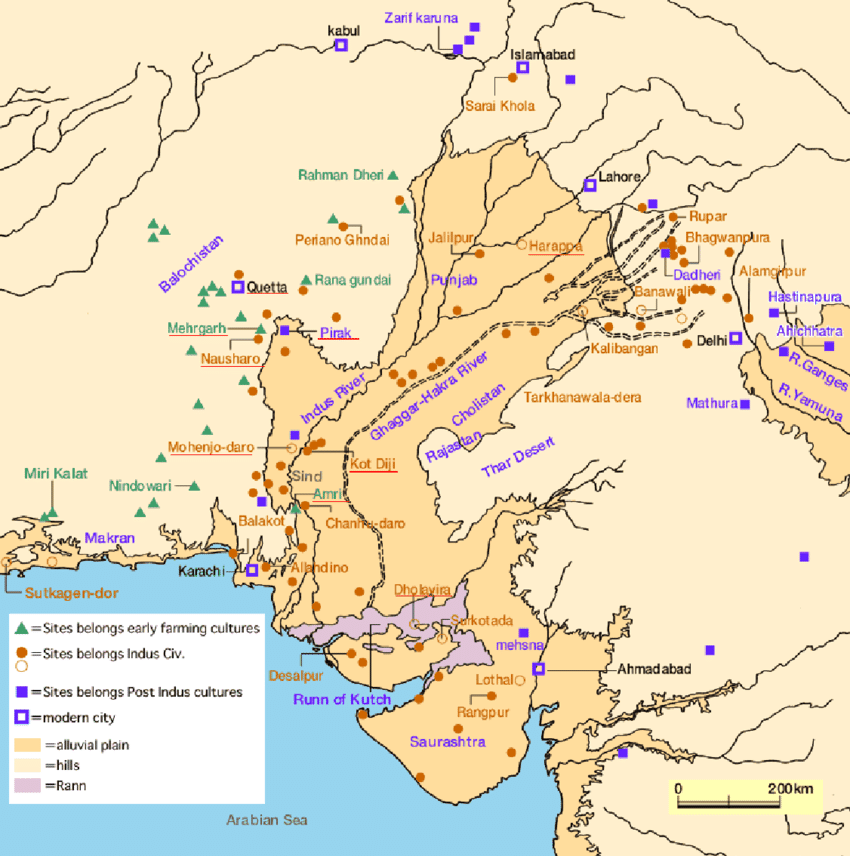
View full size image or download
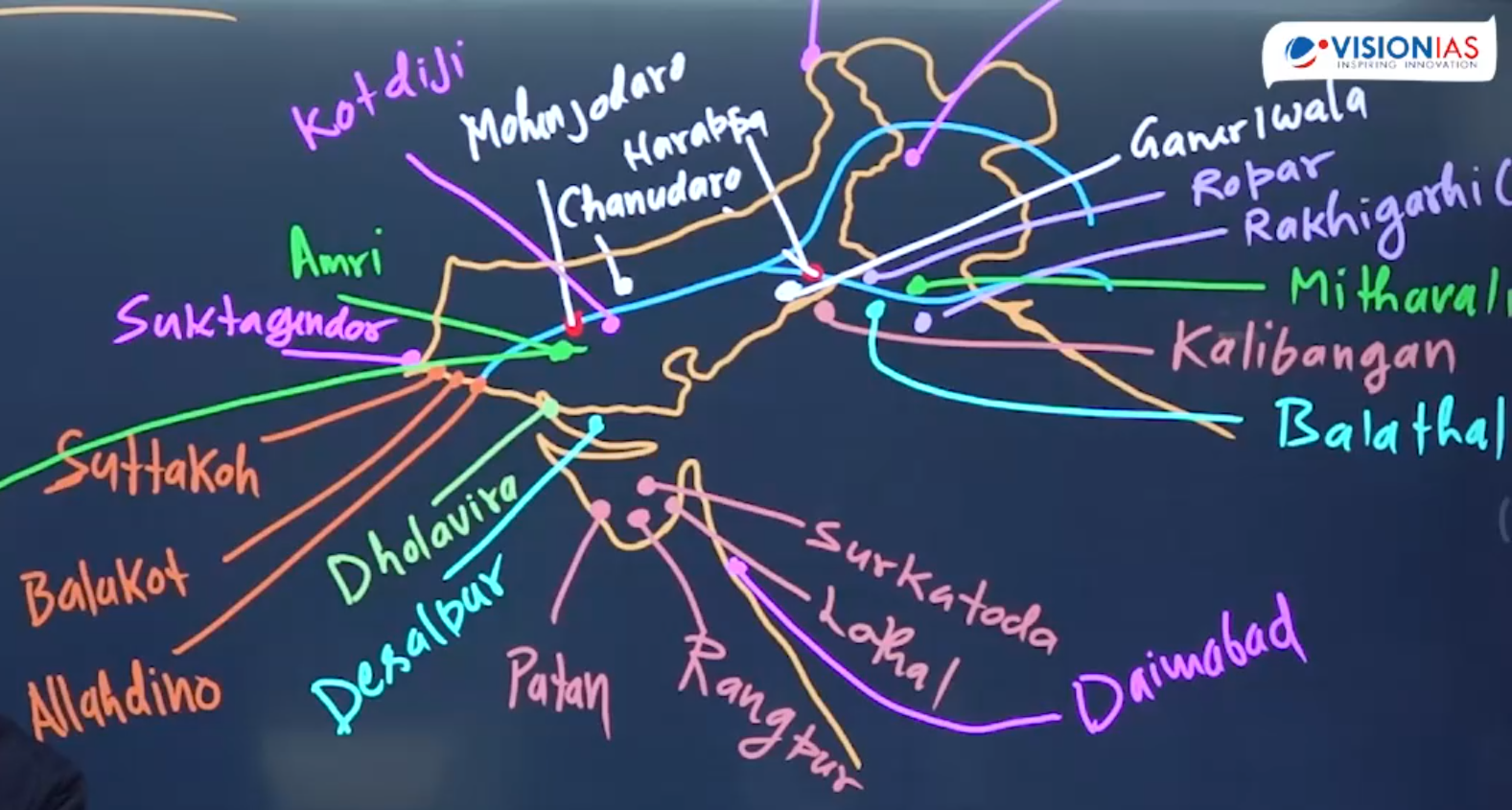
View full size image or download
- sites dump: Mohenjodaro, Harappa, Kotdiji, Chanudaro, Amri, Suktagendor, Shortugai, Manda, Ganeriwala, Suttakoh, Balakot, Allahdino, Dholavira, Desalpur, Ropar, Rakhiharhi (Bhirana), Kalibangan, Lothal, Rangpur, Surkatoda, Patan, Daimabad, Balathal, Mithavali, Amri
General features
- generally divided into 2 parts
- upper town: administrative buildings, provision of common bath and storage for grains (granaries)
- lower town: habitation of commoners
- ppl of all income categories lived inside centres of lower town
- well planned out and very good network of roads in lower town
- roads used to cut each other at right angle
- both sides of roads: drains covered with stone or brick slabs
Polity during IVC
Caution
IVC pictographic script still not deciphered most inferences not conclusive, but just a probability
- from urban planning of IVC
- no monarchial sytem
- but definite centraized administration
- believed that IVC ruled by group of rich merchants and traders
- no standing army
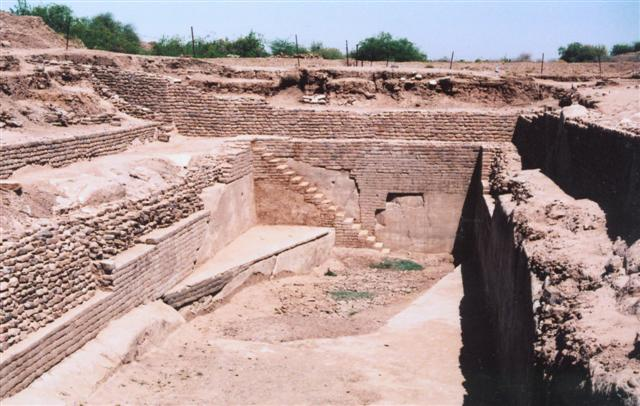
Dholavira
Dholavira was an exception in many ways. Had 3 layers of urban planning: upper, middle and lower. Believed that middle town was a military garrison where army stationed. Another unique feature radial drainage system.
Recently included in UNESCO Heritage Site list.
Economy during IVC
Keywords for revision
agri, rice, cotton, wheat, bead, bangle, bronze casting, terracotta, trade relations. Export - agri. Import - metal, semi-precious stones
- mainly dependent on agri
- cultivated variety of crops
- cotton, wheat, barley, peas, sesamum, mustard, rye, melons 🍈
- Rice was cultivated in stretch of Lothal, Rangpur and Surkotoda
- cotton textile industry heavily developed in Mohenjodaro and Harappa
- Chanudaro: bead production
- Kalibangan: bangle production
- Mohenjodaro + Daimabad: bronze casting
- terracotta & pottery production was happening in almost all towns
- metals known:
- copper, tin, silver, bronze, gold
- Trade Relatons
- very good long distance trade with areas like Kolar, Afghanistan, Magan Country (coastal area of Persian Gulf), Mesopotamia, Sumer (Baghdad), Dilmun (Bahrain) and Oman
- agri commodities and cotton textiles were major exports from IVC
- imports mainly metals (copper, gold, silver, tin) and semi precious stones (jade, zasper, amethyst, carnelian, lapis lazuli)
Society of IVC
Keywords for revision
matriarchal, non-discriminatory, inequal, fashion (mercury use), tincture
- believed to be matriarchal
- on the basis of most abundant image found from indus towns Mother Goddess
- inequal but not discriminatory
- deduced from urban planning
- different sizes of houses in same region
- mobility in society
- fashion
- very good, 10/10 👍
- (rating by history books, not me)
- jewelry: necklaces, pendants, earrings, bangles, rings, waistbands
- cosmetics: lipstick, soap, sinduur, kajal
- very good, 10/10 👍
- used tincture of cleaning and healing the wounds
Religious practices during IVC
Keywords for revision
Seals. Nature worship, male & female deity, burial
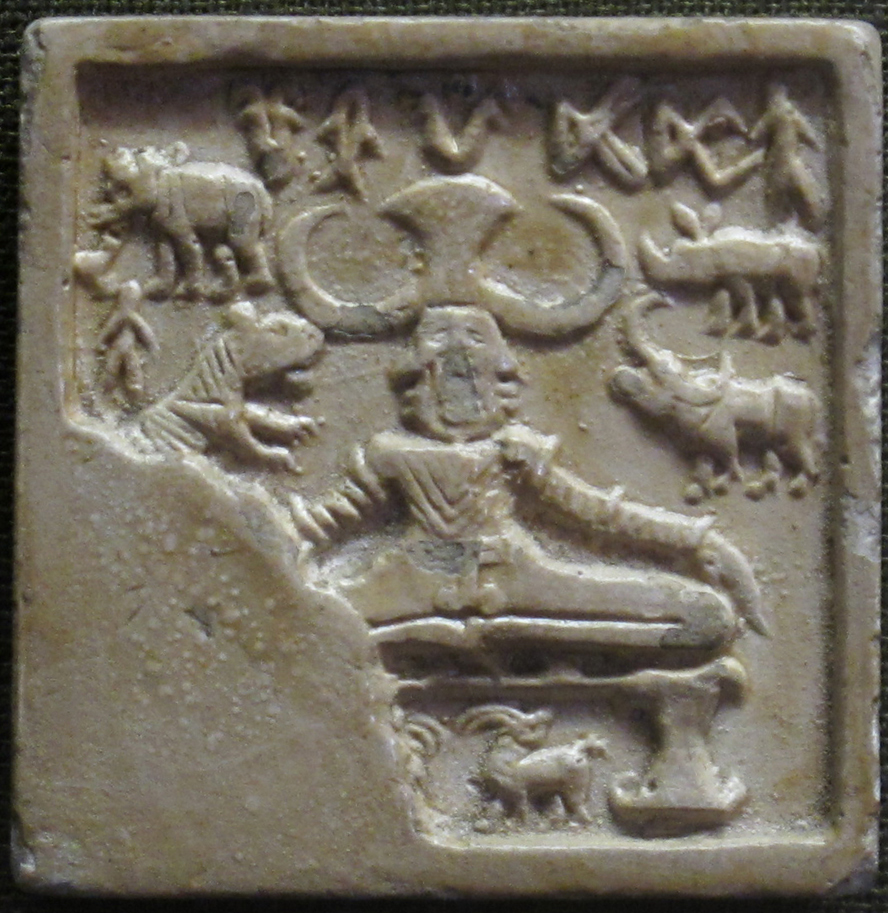
- source of info: seals
- diff images and symbols on seals provide clues about religious practices
- nature worship prevalent depicted in many artifacts
- male deity also worshipped (Pashupati seal)
- mother deity also present (Goddess of Fertility)
- after death practices:
- instances of full burial, fractional burial, partial burial, urn burial
- some sites bodies buried in middle of house; some places outside house
- direction sense not in burial practices
- along with dead person, his used materials also buried
- indicative of otherworldly beliefs of IVC
Decline & Disintegration
- Aryan Invasion Theory
- Battle of Haryupiya mentioned in Rigveda: Aryans defeated IVC
- rejected lately
- Most historians believe decline happened in long phase due to climate change, flood, inundation, frequent changes in course of rivers
- said that at height of its culture, IVC was inhabited by 60L people