Introduction
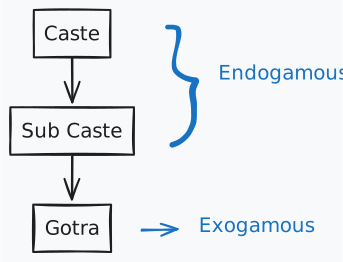
- closed system of stratification
- originally 3 Varnas; Shudras added later
- initially occupational division not rigid
- fifth group also emerged: Avarna (outcaste, untouchable)
- Varna macro concept
- but Jati/Caste ground concept
Theories of Caste Origin
Background
- historically, caste was open system, intercaste marriages allowed
- system became rigid in later Vedic period
DN Majumdar on vagueness & uncertain nature of origin of caste
There are today, as many theories regarding the origin of caste system as there are writers on the subject.
Various general theories are:
- The Divine Origin Theory
- Karma and Transmigration Theory
- Occupational Theory
- Tribes & Religious Theory
- Racial Theory
- Color Theory
- Broken Men Theory
Point Wise Explanation
- The Divine Origin Theory
- Shastra, Purana
- leads to feeling caste established by order of god
- supported by Manusmriti
- Karma and Transmigration Theory
- caste determined by one's action (Karma) in past incarnations
- cope for lower caste people
- justification to caste based DoL
- Occupational Theory
- by Nesfield: occupation is lone factor for development of this system
- initially open, but later on hymns, rituals became complex some ppl specialized in that (Brahmins)
- Tribes and Religious Theory
- gradual & silent historical change from tribal identity to caste identity
- believed that most lower caste today were formerly tribes
- Racial Theory
- by Herbert Risley The People of India 1908
- racial differences & endogamous marriages led to origin of caste system
- after emigration of Indo Aryans, we borrowed it. Indo Aryan society also in 4 classes
- priest
- warrior
- cultivator
- artisans
- Color Theory
- Varna means color
- the class which retained utmost purity of color by avoiding inter mixture normally gained precedence in social scale
- Irawati Karwa: rejects this; Varna meant class in early literature & grammar
- Broken Men Theory
- by Ambedkar
- disagreed with all prevalent theories; considered them ideological devices of Brahminical class to maintain its superiority over other classes
- BMT said Shudras were tribal people defeated in War
Features of Caste System
Overview
- Principle of purity and pollution
- Bougle identified 3 core features - hereditary occupation, hierarchy & mutual repulsion
Some commonly understood features of caste system:
- closed form of stratification
- hierarchy
- caste based DoL
- endogamy
- feeding & social restrictions
- civil & religious disabilities
- social mobility
- common name, descent
Point Wise Examples
- Closed Form of Stratification
- individual socio-cultural identities fixed by birth (one cannot change)
- can change religion but caste immutable
- social mobility possible across generation, but not in single generation
- Hierarchy
- deemed to be core feature
- identified by Srinivas, Ghurye
- but Srinivas lower caste may be dominant (see: Dominant Caste Theory by MN Srinivas)
- castes arranged in order of their deemed superiority
- Caste Based DoL
- occupations graded based on principles of purity and pollution
- but at times India ruled by non Kshatriyas
- KM Pannikar: Nandas were last true Kshatriyas
- Endogamy
- Ghurye termed this as core
- Feeding & Social Restrictions
- strict rules for inter dining in Smritis, serving of kachcha and pucca food
- social interactions also limited
- Civil and Religious Disabilities
- separate wells, schools
- perms from upper caste to construct a pucca house
- restrictions on temple entry, performance of rituals etc
- Social Mobility
- caste mostly closed, but MN Srinivas Sanskritization
- Royal patronage, conversions etc other avenues of mobility
- Common Name, Common Descent
- sub castes, castes often trace origin to common real or mythological personality
Many of the disabilities are diluted because of urbanization, secularization, modernization etc. Occupations diverse and based on skill & merit (not ascriptive). Many disabilities are legally banned.
Caste in Other Religions
- due to cultural diffusion
Caste in Christians
70-80% Indian Christians are Dalits who converted to escape hardships of caste system (untouchability), particularly during the colonial period when missionaries pursued conversion activities.
2 reasons for caste system in Christians
- Influence of Hinduism
- Existing Caste-like Internal Classification b/w Christians
- Upper Caste Syrian and Latin Christians
- Syrian Christians continued practising untouchability in Kerala to maintain higher status
Examples of Hindu influence in Christianity
- St. Thomas Christians (Kerala) accord themselves high states as they regard themselves as erstwhile Namoodris, Nairs
- Many converted people in Goa, Kerala retained caste status
- Original Hindu Barhmins in Goa became Christian Bamonns
- Kshatriya, Vaishya Vanis became Christian noblemen called Chardos
- Christian clergy became almost exclusively Bamonn
- Shudras became Sudirs
- Dalits became Maharasand Chamar
Caste in Muslims
Islam considered eglitarian but regional variations due to cultural contact w/ other cultures, places.
Revision Keywords
- ashraf (foreign), ajlaf (converts)
- sayyed, sheikh, mughal, pathan upper strata
- arzal - like untouchables
Full Content
- some parts of india muslims divided as Ashraf & Ajlaf
- Ashraf superior (foreign ancestry)
- Non Ashraf are assumed to be converts from Hinduism drawn from indigenous population
- historically, Sayyed, Sheikh, Mughals, Pathans formed upper strata (i.e. Ashrafs, or rulers)
- converts were Ajlaf, lower order
- among first generation converts
- Brahmins Sayyed
- Rajput Sheikh, Mughal, Pathan
- next converts were from occupational casts
- Jalaha (weaver)
- Naai (barber)
- Dhuniya (cotton carder)
- Kumhar (potter)
- Teili (oilment)
- MN Srinivas: Muslim jatis in many ways are comparable to Hindu Jatis
- specialized occupations
- gradation of status
- Arzal: (“degraded”) similar to untouchables
- caste division not strictly on purity pollution, but other considerations
- Sectarian (Sunni or Shia)
- Ethnic (eg. Sindhi, Baloch, Punjabi)
- Tribal/clan affiliation
- religious orientation within the sect (Ismaili, Isnashari, Ahmedi etc)
Perspectives on Caste
- both cultural & structural phenomenon
- Cultural: system of value, beliefs, practices associated w/ particular stratum
- Structural: specific pattern of inter relations among various castes on basis of various disabilities & restrictions
- subscribed by Andre Beteille, Dipnkar Gupta etc
- attributional & interactional
- Attributional: features associated w/ caste system
- Bougle used this perspective to focus on 3 key features - heredity, occupation & hirerachy
- Ghurye identified 6 features
- Interactional: how castes are actually ranked wrt one another
- Beteille liked this
- Attributional: features associated w/ caste system
Ghurye’s Perspective on Caste System
MN Srinivas’ Perspective on Caste System
Dominant Caste Theory by MN Srinivas
Louis Dumont’s Perspective on Caste System
Andre Beteille’s Perspective on Caste System
Dumont vs Beteille
| Tag | Dumont | Beteille |
|---|---|---|
| Works | Homo Hierarchicus - Caste System and Its Implications 1966 | Caste, Class and Power - Changing Patters of Stratification in a Tanjore Village 1965 |
| Perspective | Structural Indological | Weberian Trinitarian; Multidimensional |
| Methods | Book View | Direct observation |
| Key Ideas | Purity - Impurity | Caste, Class and Power Nexus |
| Features | - Hierarchy is core to Indian society, while western society based on equality - hierarchy understood in terms of purity - pollution - implicit notion of superiority, inferiority | - ritual status not the only determinant of structural relations - power & caste also play role - villages integrated w/ wider society - landed upper class elites no longer the controlling authority |
| Future of Caste | Ritual status will be significant, but substantialization of caste going on. Change in society and not change OF society | Social dynamics to become more complex. Stranglehold of caste on social structure to become weaker as caste, class & power nexus grows |
| Criticism | Too much indology, sweeping inferences drawn from Sanskritic classical text which contradict today’s ground reality | Narrow empiricism, single village study cannot be generalized for all of India |
Dipankar Gupta’s Perspective on Caste System
Untouchability
- various types of segregation imposed on individuals/groups within cultural framework of caste
- worst form of social discrimination
- exclusion, humiliation, subordination, exploitation
- 2 contexts
- restrictions
- social disabilities (prohibition from wearing new clothes, shoes)
- social isolation
- religious disabilities
- separation of roads, wells, working at right (so that even their shadow doesn’t fall on Dwijas)
- no ownership of property
- relative untouchability based on hierarchy
- restrictions
Forms of Untouchability
- Prasad in a study in 50 AP villages, enumerated 150 forms of untouchability
- violence is extreme form of untouchability
- 2020 Annual Report of NCRB: 50K cases of crime against Dalits
- UP had highest cases, then Bihar
- even Institutions of higher edu have succumbed to discrimination
Common forms of Untouchability that still exist
Revision Keywords
- segregation in civil life
- occupational limitations, manual scavenging
- habitation segregation
- ritual segregation
- marital segregation
- cultural segregation
- political segregation
- economic exploitation
- violence
Point Wise Examples
- Segregation in civil life
- social mixing, separate burial grounds paths etc
- Puruda Varnar (TN): sub caste w/ duty of washing clothes, providing services to other untouchables. They are deemed untouchables even by untouchables themselves. They have nocturnal sub human existence.
- Occupational Limitations & Manual Scavenging
- 2022: 1.2M manual scavengers
- 98% from lower caste
- 95% women
- Irony: most manual scavenger employed by railways & municipal bodies
- tanning, lifting carcasses, removing hides etc
- Habitation Segregation
- Ritual Segregation
- 2021: reports of denying temple entry to Dalits in Puri (Odisha)
- Marital Restrictions
- esp. in North India (Haryana, UP, Punjab)
- social groups against inter caste marriage
- as of 2022: several state govt (Haryana, MP, Karnataka) offer cash incentives to intercaste couples (i.e. one spouse from SC)
- yet inter caste marriages very low
- Cultural Segregation
- Dipankar Gupta: separate cultural traditions been developed by diff cast groups
- under previous Devdasi system (often prostitution) had predominantly Dalit women
- Political Segregation
- earlier Dalits prevented from casting vote
- parties like BSP helped improve their political standing
- Dalit sarpanch often given ill treatment by dormant caste
- Economic Exploitation
- most bonded labor Dalits & lower castes
- Dalits even today denied market wages
- avg land holdings lowest among dalits
- Sukhdeo Thorat (former UGC charman): Dalits in India: Search for Common Destiny 2009 75% Dalit households are landless or near landless find jobs only as low paying casual labour
- Violence
- tool of suppression
- NCRB 2019 stats: 50K cases of crime against dalits
- Other forms
- postmen don’t deliver letters to dalits
- teachers call students by caste names
- Indian Institute of Dalit Studies 2014 study: 30% dalit kids got less food in Mid Day Meals
- Dalit kids seated separately during mid day meals
- rations for dalits fixed separately at PDS/ration shops
Perspectives on Untouchability
- Ghurye: traced to post Vedic period
- Vivekananda Jha: gave more detailed account and traces origin in 4 phases
- Ambedkar: Broken Men Theory
- MN Srinivas: structural functionalism
- Dumont: pure and impure
- DP Mukherji: dialectical approach
- untouchability imposed by higher caste on lower caste
- Berreman: rejected unity perspective
- considered untouchables as outsiders in Hindu caste system
- birth to religions like Buddhism, Jainism
- reformative movments
- Bhakti Movement
- Neo Vedantic Movements
- Arya Samaj
- Ramakrishna Mission
- Sanskritization Movement
Gandhi’s Perspective on Untouchability
Revision Keywords
- varna vyavastha, ashram vyavastha ok, but pls reform and untouchability exploitative
- support temple entry, anti caste mvmt; against separate electorate
Full content
- supported Varna Vyavastha & Ashram Vyavastha but not happy with present shape of caste system
- varna vyavashtha united society, but untouchability was exploitative
- continuing untouchability slow destruction of Hinduism
- compared with apartheid
- supported temple entry, anti caste movements like
- Vaikom Satyagrah
- Guruvayur Satyagrah
- opposed separate electorate for dalits
- 1932, Yervada Jail: fast unto death to prevent seat reservation for Dalit
- Poona Pact
- estd. Harijan Sevak sangh 1932
Gandhi Ji
Untouchability has made Indian untouchables in the whole world.
Gandhi Ji in Harijan (1936)
Untouchability as a blot upon Hinduism and must be removed at any cost. Untouchability is a poison which if we do not get rid of it in time, will destroy Hinduism.
Ambedkar’s Perspective on Untouchability
Revision Keywords
- western educated, liberal
- annihilation (no reform)
- legislative/political empowerment: separate electorate, against Gandhian views
- against hindu social order
Full Content
- belonged to depressed caste Mahar
- western education, liberal spirit
- wanted changes in social structure
- radical view, wanted annihilation (no reform)
- dehumanized beyond repair
- rejected mythological views on caste system
- termed untouchables as Broken men
- considered Gandhian views utopian
- wanted separate electorates
- considered legislative measures & political empowerment as only ways to get ride of untouchability
- no place of hereditary status
- hindu social order failed to uphold liberty, equality, fraternity
- Christophe Jaffrelot: Ambedkar and Untouchability 2004: Ambedkar employed 4 strategies to fight caste system
- build respectable identity for dalits by reinterpreting history
- build legitimate electoral space
- improve conditions of dalits by working w/ those at top
- convert en masse outside Hinduism if Dalits not given just & humane treatment
- recommended abolition of religion/caste based appt in religious institutions, advocated state appt. priests in temples (merit)
- converted to Buddhism weeks before death
- access to political power, political rights
Broken Men Theory (from The Untouchables 1948)
- in ancient times, due to war, consequent defeats, group of tribes became fragmented, hence wandering broken men
- followers of Buddhism, refused to accept dominance of Brahminism
- Brahmins started branding Broken Men as untouchable
- gradually, practices of broken men dubbed polluted
Gandhi vs Ambedkar
| Gandhi | Ambedkar |
|---|---|
| challenged caste system from above | challenged caste system from below |
| Varna Vyavasthra needed reforms, but integral | Varna Vyavastha product of Brahminical distortions. Theory of Broken Men. |
| views evolved slowly, remained spiritual, sought social change within Hinduism | Radical views, wanted to use state for establishing forward thinking social policies |
| solution gradual change of hearts of Hindu | envisaged political economic solution (change of structure) |
| gave new name - Harijan (children of god) | rejected Gandhian notion as soothing palliative to disguise harsh reality. Dalit. |
| every work sacred | work assigned to untouchables not held in similar respect, most dehumanizing |
| wanted reformation of caste, hindu society | wanted annihilation of caste |
Reformation of Caste System
Summary
- brits brought new ideas, bureaucratic system, new transportation, capitalist economy
- secular education led to social reforms
Full Content
- w/ brits, came modern ideas, bureaucratic systems
- influence of traditional bodies (panchayats) reduced
- public employment by merit, not caste
- education secular
- new modes of transportation, civic systems made physical segregation difficult
- shift from agrarian to capitalist economy shifted focus from caste to profits
- top down machinery
- social reform from below by enlightened individuals
- Brahmo Samaj, Arya Samaj, Prarthna Samaj: equality for all
- Caste Disabilities Removal Act 1850
- but never implemented on ground
Rise of Anti Caste Social Movements and Reforms
- early works by Brahmo Samaj, Arya Samaj, Ramakrishna Mission etc
- advocated for equal society w/o social divisions
- southern states, Bombay gave birth to purely anti caste mvmts
- early reformers not even untouchables
- lead by WEMC
- 1918 1st Depressed Classes Conference, Bombay
- new vocab - dalit, harijan
- equal human being who were victims of atrocities by others
- early revolts: Channar Revolt (19th century, Kanyakumari)
- lower caste women had to pay breast tax
- Satyashodhak Samaj Maharashtra 1873: by Jyotiba Phule & his wife Savitribai Phule
- worked against untouchability & upliftment of lower caste women
- attacked brahmin priests who insisted on acting as intermediaries b/w God & devotees
- Kerala: Ayyankali one of the earliest dalit leaders who fought for civil rights
- public roads, right to ride bullock cards, wear clothing of choice etc
- direct, confrontationist approach
TODO: complete this section
State and Non State Steps Towards Abolition of Caste based Discrimination
- reservation
- laws to end, prohibit, punish caste based discrimination
- Travancore Cochin Removal of Disabilities Act 1825 was first anti untouchability legislation in india
- CoI prohibits untouchability under Article 17
- Protection of Civil Rights 1955
- Prevention of Atrocities ACt 1989
- repeated laws reflect how laws alone can’t fix social issue
- monetary incentive for inter caste marriage (MP, HR)
Contemporary Dimensions of Caste System
Mobility in Caste System
- caste not rigid closed until late Vedic period
- a low caste person like Valmiki could compose epic such as Ramayana
- different relative dominance across time
- Buddhist scriptures Kshatriya superior
- Jain scriptures Vaishya superior
- KM Pannicker: Nanda last true Kshatriya. All further rulers lower caste
- caste mobility
- Srinivas: mobility sources
- fluidity of political system
- matrimonial alliances
- modern occupations highly secular (merit based)
- democracy, equality has weakened caste basis
Caste and Class Nexus
- Dumont
- Caste ascriptive attributes
- Weber: castes are most adv form of status based stratification
- social honor linked
- class dimension became apparent during british rule
- Andre Beteille: hierarchies of caste & class in villages overlap to some extent, but also cut across
- Yogendra Singh: both reflect same social reality
Caste and Politics
The issue
Elections not fought for real issues, but around identity politics and sensationalized caste issues. Cleavages in society are exacerbated for political gains. Breeds animosity among castes.
- ideologically opposite, but in practice overlapping due to similar end goal of power seeking
- brits provided initial fertile ground
- caste & religion often used as emotional tool for managing masses
- political mobilization based on caste
- Ambedkar wanted political empowerment of depressed classes
- The Republican Party 1956
- Panchayati Raj fuelled these dynamics
Andre Beteille on Caste & Politics
Westernization moving ppl away from caste identity. But Caste politics bringing people closer to number based caste grouping.
Rajni Kothari
It is not politics that gets caste-ridden; it is the caste that gets politicized.
Caste: Change and Continuity
Caste differences in some ways have deepened in modern times.
- marriage between upper and lower caste still rare
- matrimonial sites tend to promote endogamous marriages
brahminmatrimony.compunjabimatrimony.com
- NCAER 2014 Survey: only 5% intercaste marriages
- matrimonial sites tend to promote endogamous marriages
- Harold Gould: Rickshawallas: The Social Organization of an Occupational Category 1974
- rickshaw pullers of different caste, interacting
- but at home observe caste practices
- workplace separate from private lives
- Many big industrialists are from traditionally higher castes and menial jobs are done by lower castes even today
- Panchayat Raj reinforces caste based power (Andre Beteille)
- +ve discrimination policy after independence caste based consciousness and collective caste identity strengthened
- due to industrialization, urbanization, shared living spaces (flats)