Facts (quote in exam)
- 700 ST under Article 342
- 2020-21 Annual Report of Ministry of Tribal Affairs
- population of ST 104.5M (i.e. 8.6%)
- sex ratio 990
- literacy rate 59%
- 60% school dropout rate
- NSSO: ST poverty: 45.3% (rural) & 24.1% (urban)
Definitional Problems
- enormous diversity, complex contemporary developmental profile
- no universal definition to capture identity
- not all live in forest eg Dublas (Surat)
- not all isolated eg Bhil Santhals
- some tribes self sufficient, economically sound eg Khasi, Gond, Bhil
Caste & Tribe
- Srinivas’ Sanskritization model: tribals enter the caste system
- Ghurye: tribals backward hindus
- classified tribes from hindu perspective
- Hinduised tribes partially hinduised tribes hill section poeple
- DN Majumdar
- Primitive tribes tribes w/ degree of association hinduised tribes
- Elwin
- most primitive individualistic detribalised tribal aristocrats
- modern understanding: caste tribe
- caste social institution regulated by DoL, hierarchy, purity/pollution, civic/religious disabilities
- tribe absence of features of caste
- Herbert Risley: egalitarian social order
- exposure to mainstream society tribes borrowed certain caste like characteristics
During British Period
- no rigid distinction b/w caste & tribe
- viewed whole Indian society as largely inward looking
- after anthropological studies, acknowledged that tribals have distinctive lifestyle & religion
- separate from caste groups
- used single term for very disparate set of communities for administrative convenience
Ethno centric assessment
- earlier viewed at par w/ stage of primitive bestiality
- classical evolutionary theories of anthropologists during 1790s - 1820s called them remnants of early stages of humanity w/ savagery and barbarism as defining features
- defective view, biased by European racial mindset
- lacked subtle understanding of ethnic grps in India
Views of Indian scholars
More empirical, rooted in reality.
- SC Roy: jana (tribe) & jati (caste) existed side by side since long
- Mandelbaum: no strict cultural diff b/w caste & tribe
- SC Dube: Great Tradition of Hinduism & Little Tradition of tribes existed together since long
- AR Desai: classified tribes by degree of assimilation into mainstream society
- Beteille: differentiated tribal groups on basis of language, religion, degree of isolation
Present general definition
- group of individuals w/ shallow (recorded) history
- indigenous
- particular territory
- tied by close bonds of kinship
- endogamy
- distinct custom, ritual, beliefs
- simple social ranking / political organization
- common ownership of resources
Mandelbaum's 7 features of Tribals
- Kinship: extends beyond conventional nuclear-joint binary
- Lack of clearly defined hierarchy
- absence of strong, complex, formal organization
- communitarian basis of land holding; no concept of private property
- little value on surplus, capital or market trading
- segmentary character
- lack of distinction b/w form & substance of religion
- distinct psychological bent for enjoying life
SC Dube's 5 fold classification of Indian tribes
- Aboriginals in seclusion
- Association w/ neighboring non tribal society, but maintaining distinctiveness
- Living in villages w/ caste, sects & religious groups but maintaining identity
- Degraded to states of untouchables
- Assimilated into mainstream & enjoy high socio, eco, pol status
Definition of what they are not
- no religion w/ written text
- no state/ political form
- no sharp class divisions
- no deep notions of history
- no caste
Positive Characteristics
Permanent Traits

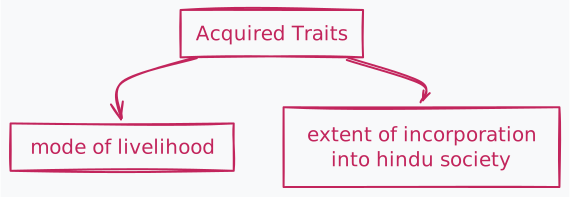
Acquired Traits
Other parameters
- Language
- Dravidian
- Austric
- Tibeto Chinese
- Race
- Herbert Risley: The peoples of India 1908: classified in 7 races
- Geographical Spread
- Economic Activity
- fishermen
- food gatherers, hunters
- shifting cultivators
- peasants
- industrial workers
- Degree of cultural contact
- Verrier Elwin: 4 types
Geographical Assertion
- tribes consider themselves original settlers
- emotional attachment w/ land
- territoriality the crux of most political mvmts
- Munda Rebellion
- Anti Mining protests 2009-10 by Dongria Kondh (Niyamgiri, Odisha)
- tri axis of mining projects
- tribal interest
- economic exploitation of resources
- environmental cause
- geographical mapping can tap potential of tribal inhabited areas
- organic farming
- traditional herbal medicines
- link tribal welfare with market
Colonial Policies & Tribes
Two major elements of British policy towards tribes
- favored isolation from mainstream
- 'civilizing' (refer: White Man’s Burden)
Followed policy of exploitation & alienation. Brought them under land revenue administration, exploited forests, tribal lands.
Colonial Rule & Tribal Distress
- Initial interference led to
- Chaur Uprising 1832
- Kol and Ho Uprising 1832 (Chota Nagpur)
- Satara Revolt 1840
- Santhal Rebellion 1856
- led to policy of isolating tribals from mainstream
- GoI Act 1870: provided some protection
- Scheduled Districts Act 1874: creation of certain backward tracts
- GoI Act 1919: created Excluded & Modified Excluded Areas w/ diff administrative structures
- GoI Act 1935: Excluded & Partially Excluded Areas
Brit policy had 2 extremes - either complete non interference or complete assimilation. Made land a market commodity, forests rapidly cleared, mineral belts exploited aggressively. Issues of bonded labour, forced taxation, artificial restrictions on mvmt. Missionaries targeted them for conversion
Brits wanted Tribals to settle down & become peasants income revenue.
- Late 19th century: tea, coffee plantations, mining
- needed cheap labour tribals
Proactive forest policy
- Forest Acts deprived traditional forest rights
- very exhaustive Elwin: every tribe violated many of them in single day
- eg Teak was state property
- very exhaustive Elwin: every tribe violated many of them in single day
- acts like grazing cattle, collecting firewood were illegal
- Vidyarthi: alienation not just economic; emotional & cultural too
- trees, rivers, mountains carried symbolic/ religious meanings
Tribal Integration & Autonomy Issues
- Developmental View: tribals living in condition of under development & be rightfully brought into mainstream
- Autonomy View: modern definitions of development should not be imposed onto tribals who have been living in harmony w/ nature since ages
- need balance b/w integration & autonomy
- autonomy desired for developmental policies to organically evolve to suit tribal culture, lifestyle
- development for basic health, education
- Cultural Integration Perspective
- byproduct of Caste Continuum proposition
- SC Roy: Jana-Jati
- Ghurye: tribe backward hindus
- Political/ Economic Integration perspective
- Surajit Sinha: understood integration in terms of economic necessity of farmers, miners to have cheap labour. Gave concept of tribe-peasant continuum
Post Independence issues
- integration directed from above, not below
- Walter Fernandes (1991): 30M ppl displaced by developmental activities in past 50 yrs - 42% tribals
- number of tribal labourers also inc during same priod
- higher incidences of maternal mortality, child mortality
- poverty 50% more than national average
- neglected their on needs/desires
- integration on terms/benefit of mainstream
- even today, land alienation, displacement happens, forests are taken away, mining/dam projects affect them
- Virginius Xaxa: tribal integration post independence only a constitutional prescription & not empirical reality
Tribal Integration & Autonomy in 21st Century India
- Tribal Panchsheel: approach adopted by Nehru
- tribal dev be based on old genius of tribals
- trained to participate in modern mainstream economic & political activities
- tribal dev policies should receive inputs from needs of locals
- no development project that alienates them
JL Nehru
Tribal areas have to progress and progress in their own way.
Memorize Tribal Panchshleel - CLTOR
- C: Culture (encourage them to promote)
- L: Land Rights (Respect)
- T: Team (their own)
- O: Over–administer (don’t)
- R: Results (not by money but by human character evolved)
- Narmada Bachao Andolan 1980s by Medha Patkar, Baba Amte
- failed, but raised awareness about env issues, tribal displacement
- NC for ST
- ST & Other Traditional Forest Dwellers (Recognition of Forest Rights) Act 2006
- PESA
- Forest Rights Act
- 47 seats reserved in LS for ST
- Constitutional safeguards
- Art 15(4) (refer Article 15)
- Article 46 (refer Directive Principles of State Policy)
- Article 339(1): President may appt commission to report on administration of Scheduled areas & welfare of SC/ST in a state
Persisting issues
- feeling of deprivation
- ineffective implementation of policies
- exploitation by money lenders, forest officials, merchants, traders, forest contractors
- low edu levels, healthcare access
- low pace of reforms
- Naxalite movements
- unrest due to mining projects
- Anti Mining protests 2009-10 by Dongria Kondh (Niyamgiri, Odisha)
Recent Efforts
- Eklavya Model Residential Schools 1997
- Scholarships
- Vanbandhu Kalyan Yojna 2014: for holistic dev of tribals and instititutional mechanisms for delivery of g&s
- Tribal Cooperative Marketing Development Federation of India (TRIFED) 1987: to sell tribal products in mainstream markets
- Van Dhan Scheme 2018: set up Van Dhan Kendras (community owned forest produce)
Virginius Xaxa Committee
- empower gram sabha for linear acquisition
- acquired but unused land be returned to tribals
- tribal co-ops for mining
- no big dams
- naxal killings be probed by judicial enquiry