History
- started in 1770, w/ establishment of Bank of Hindustan
- later, 3 presidency banks set up
- Bank of Calcutta in 1806
- Bank of Bombay in 1840
- Bank of Madras in 1845
- 1921: all these banks amalgamated to form Imperial Bak of India
- functioned till 1955 then became the SBI 🥴
- Royal Commission on Indian Currency 1922: recommended operation of money mgmt in 1926
- Reserve Bak of India Act 1934 introduced
- Nationalization of banks took place from 1969.
- 14 pvt banks nationalized in 1969
- 6 more nationalized in 1980
- Post 1990, many nationalized banks amalgamated gradually
Reserve Bank of India
- started ops on 1 Apr 1935
- started as shareholder’s company, but nationalized in 1949 under RBI (Transfer of Public Ownership) Act, 1948
- first governor Sir Osborne Smith (1935-37)
- first indian governor CD Deshmukh (1943-49)
- Manmohan Singh only PM who also was RBI governor
- emblem Tiger (earlier lion) and Palm Tree

- variety of roles
- overseeing monetary policy
- regulation, supervision of financial system, payment system
- mgmt of foreign exchange
- issuing currency
- promotion of national objectives
- crediting short term loans to govt
- Indian Coinage Act, 1906: coins can be issued upto denomination of 1000
- Reserve Bank of India Act, 1934: currency notes upto denomination of 10,000
Functions
- issuer of banknotes
- monopoly except on 1 rupee note
- banker to govt
- banker’s banker
- lender of last resort
- custodian of foreign exchange reserves
- controller of credit or money supply
- regulator of banks
Structure of Banking System
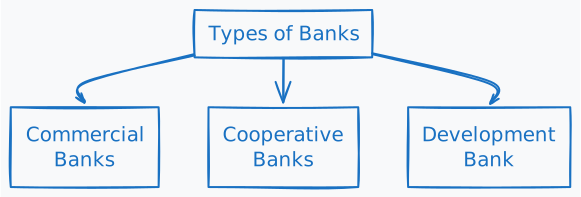
Commercial Banks
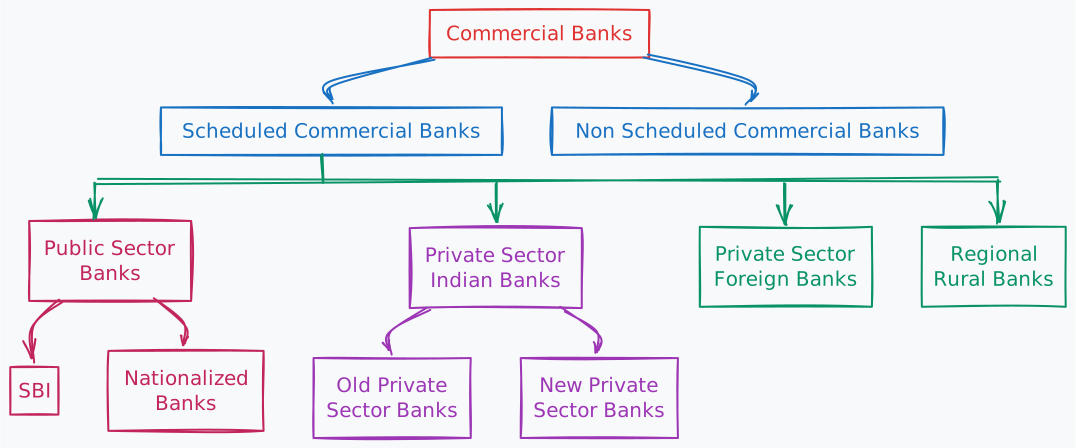
Special Benefits with Scheduled Commercial Banks
- can approach RBI for financial assistance at bank rate, repo rate, MSF etc
- but are bound by certain obligations like maintaining SLR, CRR etc
Amalgamation of Banks
- 2020: 10 PSB amalgamated into 4 PSB
Benefits of Amalgamation
- create banks with larger scale to compete with global banks effectively
- greater scale and synergy through consolidation
- cost benefits
- provide impetus to amalgamated banks by increasing their ability to support larger lending & greater financial capacity
- access to wider talent pool, larger database competitive advantage
- adoption of best practices across amalgamated entities
Regional Rural Banks
- to provide sufficient banking & credit facility for agri & other rural sectors
- set up on recommendations of M Narasimham Working Group
- mobilize deposits, primarily from rural/semi urban areas & provide loans to small, marginal farmers, agri labourers, rural artisans and other segments of priority sector
- sources of funds NABARD, deposits, owned funds, sponsor banks, SIDBI, National Housing Bank
- supervised by NABARD
- eg.
- Paschim Banga Gramin Bank
- Andhra Pragathi Grameena Bank
Co-Operative Banks
- incorporated and registered under the States Co-Operative Societies Act. Also through following CG acts
- Banking Regulation Act 1949
- Banking Laws (Co-operative Societies) Act 1955
- involved in all kinds of activities
- production
- marketing
- distributing
- possessing
- servicing
- banking
- one member one vote
- no profit no loss
- customers are owners of co-op banks
- main focus on agri & rural sector lending
- 2020: GoI approved to bring coop banks under RBI
Non Banking Financial Companies
- engaged in business of loans and advances, acquisition and selling of shares, bonds, debentures, leasing, insurance, chit fund etc
- 2016: GoI allowed 100% FDI in “other financial services carried out by NBFC”
- NBFC’s financial assets should constitute 50% of gross income
- not all NBFC regulated by RBI
| Banks | NBFC |
|---|---|
| can accept demand deposits | can’t accept demand deposits |
| part of payment system | not part of payment system |
| can issue cheque drawn on itself | can’t issue cheques drawn on itself |
| deposit insurance facility available | no deposit insurance facility |
| required to maintain reserve ratios | not required to maintain ratios |
| regulated under Banking Regulation Act 1949 | regulated under Companies Act 1956 |
| FDI upto 74% for pvt banks | 100% FDI allowed |
Shadow Banking
- set of markets & institutions that operate partially or fully outside traditional commercial banking
- either lightly or not regulated
- not illegal, but not strictly monitored
- no direct access to central bank liquidity
- highly risky and illiquid assets
Differentiated Banking
- based on recommendations of Nachiket Mor Committee 2013
- cater or serve specific segment of customers unlike other normal universal banks
- differentiation may be based on capital requirement, scope of activities or areas of operation
- offer limited range of services/products as compared to universal banks
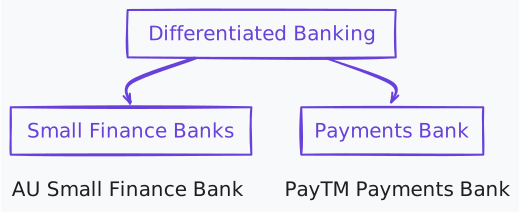
see also: