Why elderly become religious?
- Rodney Stark & Willian S. Bainbridge (1987)
- need for social support systems and heightened search for answers to life’s big questions
- Dillion & Wink (2003)
- levels of altruism, feelings of purposefulness in life’s everyday activities
- helps people age more gracefull
Religion & Consumerism
- Megachurches in USA
- Religious movies: Jai Santoshi Maa, Passion of the Christ
- Religious songs & music: $100B industry
- Religious themed merch, food
- specialized clothing for different religiouns
- stickers, decoratives etc
- jain food, halal meat etc
- Religious books, magazines
- Spirituality concerts
Religion & Consumerism from Indian perspective (Banerjee, 2005)
- Religious shopping
- teens specifically have a consumerist approach, focus on external ornaments
- rituals for well being: havan, vaastu etc
- religious goods: amulets, tabeez, sacred threads, religious photos
- pilgrimage: chaar dhaam, plush hotels and airports around imp religious places eg Ayodhya
- specific auspscious days to spend: dhanteras, akshay tritiya
- membership: eg. ISKCON
- designer religious clothings: turban, burkinis
- monetary gifts: rakshabandhan, diwali, id
Thinkers & Theories
Durkheim
Religion unites all those who believe in it.
- EB Tyler: man faces existential puzzles animism
- further to polytheism monotheism (Abrahmic)
- Max Muller: naturism earliest form of religion based on his study of Vedas
- man fears nature worships nature
- Herbert Spencer: religion worship of supernature
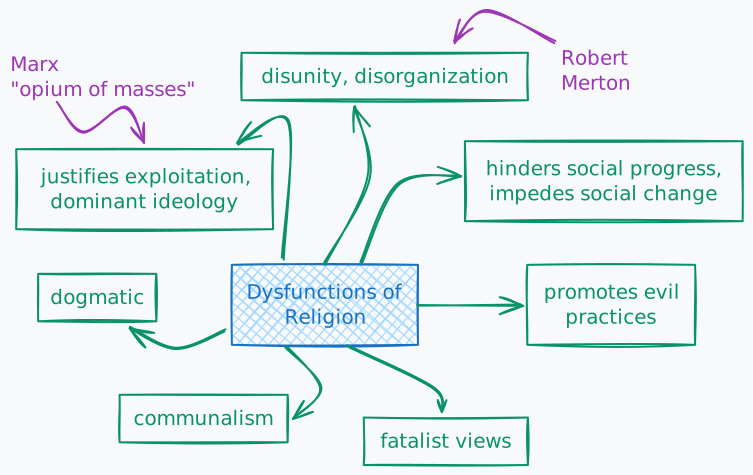
- Marx: opiate of masses; superstructure to maintain economic base. Needed due to alienation of man from himself
- hinder social progress
- make ppl dogmatic, promotes evil practices
- Weber: instrument of social change
- ascetic inner world ethos lead to increasingly goal rational society & mindset
- Durkheim: sacred/profane. Religion symbolization of society
- dual function: solidarity & regulation
- Parsons: consequences at both societal & individual level
- for individual cognitive function
- for society strengthens value consensus
- Malinowski: religion has implications for individual acts too; acts as anxiety reliever (hope over fear)
- Merton: plurality of religion dysfunctional in modern society
Ronald Robertson
Religion refers to the existence of Supernatural beings which have a governing effect on life.
But acc to Malcolm Hamilton certain belief systems (eg. Buddhism) don’t believe in supernatural beings.
Functions of Religion
Manifest & latent functions or individual & societal functions.
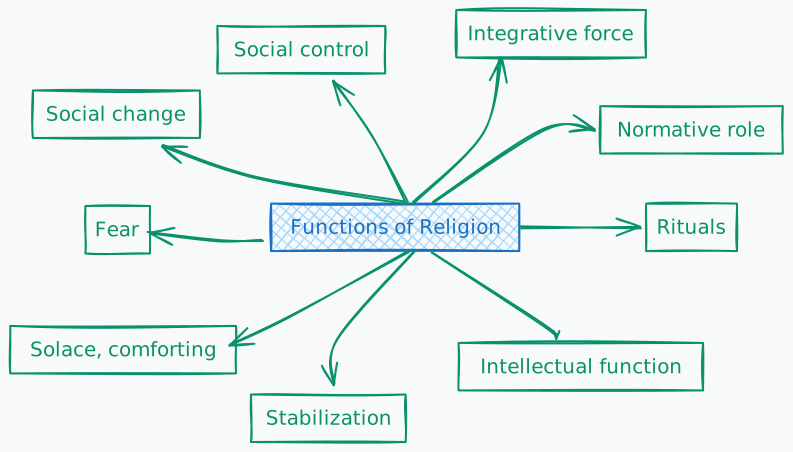
Point wise examples
- Social change
- Buddhism challenged orthodoxy of Brahminism
- Integrative force
- Durkheim: unites those who believe in it
- Social control
- concepts of sin, virtues, heaven, good, bad
- fatwas
- Intellectual function
- Normative role
- common tenets of peace, love, fraternity etc
- Solace, comforting function
- Malinowski: assisting individual to cope w/ situation of stress/anxiety
- Stabilization
- Veershaiva Mvmt by Baswesvara in South led to struggle against unreasonableness of Brahmins
- Ritual
- direct marriages, mutual relations etc
- Fear control
- supplement empirical knowledge
Dysfunctions of Religion
Theories
Classical evolutionary theories deem polytheistic religion as religion of simple societies. Monotheism is for complex societies.
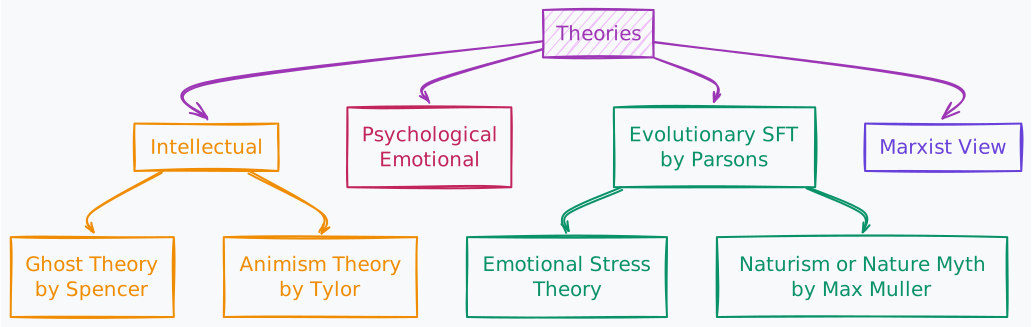
Intellectual Theories
- based on primitive logic
Ghost Theory (or Dreams Theory) by Spencer
Spencer
Ancestor worship is the root of every religion.
- appearance of dead persons in dreams
- conception of supernatural being in the form of ghost
- evidence of temporary after life
- idea of ghost grows into idea of god
- ghost of ancestor divine beings
- evolutionary view
Animism Theory by Tylor
- belief in spirits, soul
- man finds presence of spirit in every object
- refer Animism (EB Tylor)
Psychological / Emotional Theories
- based on mental states (like fear)
- fear Malinowski
- guilt Freud
- naturism Frazer
- matter of feeling Lowie
Emotional Stress Theory
- religion concerned w/ specific areas of social life which induce stress, threaten social solidarity
- crisis of life: birth, puberty, marriage, death
- also relates to unpredictable events - storms, floods etc.
- rituals (praying to rain god) helps relieve anxiety
- promotes social solidarity by dealing w/ situations of emotional stress
Naturism or Nature Myth by Max Muller
- forces of nature have supernatural power
- Max Muller: passage of time symbolic representations came to gain independent identity of their own
- early humans could not explain the world of nature
- ended up worshipping it out of fear & awe
- Frazer: primitive man in continuous struggle with nature. Rituals developed to control nature.
- criticized by Herbert Spencer, Edward Tylor, Andrew Lang
Evolutionary Structural Functional Theory by Parsons
- part of cultural system which provides more guidelines in form of beliefs, norms, values etc
- addresses certain problems of society (eg. unforeseeable events, uncertainty etc)
- calms down stress, anxiety
- provides range of answers, makes suffering meaningful
Criticism
Ignores instances where religion becomes disruptive. Gives little consideration to hostilities (eg. b/w Catholics & Protestants in Northern Island)
Marxist View of Religion
- conflict pov
- ”opium of masses”
- numbs suffering resulting from class exploitation
- man made to believe power lies in supernatural (not within themselves)
- religion external force controlling destiny (but in reality, is manmade)
- no religion in communist society
- justifies position of man in strata (eg. Karma theory justifies caste)
Lenin
Religion is a kind of spiritual gin which in which the slaves of capitalism drown their human shapes and their claim to any decent life
Collusion b/w feudal class & Church
Feudal class gave donations to the Church. In return, Church would legitimize powers of lords from the pulpit.
Types of Religious Practices
Animism (EB Tylor)
- world driven by anima/spirits
- spirit in objects around man
- benign & malavolent
- man’s happiness dependent on happiness of dead ancestors
- ancestors must rest in peace
- eg. Pitra & Shraadh in Hinduism
- rel. w/ transmigration of soul
- origin: double in dreams
- double far more dynamic, elastic, superior
- soul differentiates b/w living and dead
- during dreams at night, soul leaves temporarily
- after death, leaves permanently
- soul exists independent of its physical home
- idea of belief in spiritual beings
Monism & Pluralism
- Monism: oneness of all existences (single god)
- Islam
- Sufi
- Adwait (Hinduism)
- EB Tylor: (evolutionary theory): monotheistic religions in modern soc; pluralistic in primitive soc
- Pluralism: accommodate diff. pov, beliefs
- fertility of ideas
- mutual tolerance
- different religions of a particular religion possess same rights of worship
- Hinduism: Shaiv, Vaishnaiv, Dwait etc
- Christianity: Calvinism, Methodists, Protestants, Cacholics
- religious pluralism in India since Buddhism (500BC), widened during muslim settlements
- 8th century: Zoroastrianism estd. in India as they fled from Persia to India in large numbers
Sects & Cult
- represent religious revivalism on one hand and search for alternate religious activities on other
- also represent ossification of dominant religion & search for alternatives
- Sect: smaller, closed, different agenda than dominant religion
- Church: large, well estd. bureaucratic
Theoretical explanations for rise of sects and cults:
- result of wider process of secularization & liberalization
- traditional religion ritualistic, rigid, orthodox
- Bryan Wilson: sects result of rapid social change
- as traditional norms disrupted, ppl search for explanations, reassurance
- sects appeal to ppl who feel alienated, marginalized from mainstream society
Cult
- small grp of religious activities
- beliefs diff from dominant religion
- usually individualistic beliefs in cult
- never challenges mainstream religion directly
- based on charismatic leadership
- no concept of membership, loosely organized
- more readily accepted by marginalized sections of society
- emphasize one doctrine
- flourish in metropolitan centre, where culturally heterogeneous populations are thrown together
- impact of rapid, impinging social change widely felt here
Olridge: cults present in modern society because
| Religion | Cult |
|---|---|
| Salvation in afterlife | Relief in life itself |
| Addresses spiritual needs | Provides solution to mundane problems |
| No direct communication w/ God | Believer & devotees are face to face |
Sect
- more organized than cults
- often intolerant towards other religious groups
- desire to disassociate from existing social order
- attempt to rationalize dominant religion
- promote brotherhood, equality, common goals for its members
Peter Berger in Sociology of Religion and Sociology of Knowledge, 1969
Sect is in tension with the largest society and is closed against it.
Weber: sects likely to originate within marginalized groups. Called this theodicy (religious justification) of disprivileged as they provide alternative explanation or path of redemption. Modern sects have varied membership though.
| Sect | Cult |
|---|---|
| when memberships grows or cult leader dies in bid to become more organized religious unit | starts around charismatic personality. Eg. Buddha |
| desire to disassociate from existing social order; attempt to rationalize dominant religion | different beliefs than dominant religion, but never challenge |
| formal & definite | more volatile |
| largely closed to those not undergone a process of initiation (drinking holy water, wearing amulets). strong claim of loyalty of members | relatively open, no precondition for membership |
| more closed, membership criteria | no strict membership criteria, organization loose |
| eg. Calvinists, Methodists etc | Osho cult, Transcendental Meditation etc |
Denomination
Howard Becker
A denomination is a sect which has cooled down and become an institutionalized body rather than an active protest group.
- grows out of sect when they lose momentum
- difficult to maintain high levels of commitment for long periods
- sects either die or transform into denominations
- sect that has lost revivalist, reformist dynamism and has become institutionalized body w/ much larger following than a sect
Johnson
Denomination is what usually results when a sect becomes ‘respectable’ in the eyes of middle class society and relaxes its religious vigor.
Features of denomination
- membership drawn from all levels of society (unlike sect which is predominantly lower strata)
- binding chord of fellowship of love, service (in cult) is non existent in denomination
- generally accept norms, values of larger society even if it imposes minor restrictions upon members
- develops bureaucratic org w/ hierarchy of paid officials, similar to Church
Religion and Science
Albert Einstein
Science without religion is lame. Religion without science is blind.
- Comte: society: theological positivist
- religion dominates traditional society
- science dominates modern society
- Tylor: glorified science (infallible, embodies spirit of modernity)
- Spencer: religion, science at opposing ends
- as societies evolve, science becomes modern religion
Differences b/w Science & Religion
| Science | Religion |
|---|---|
| inquisitive, deliberative | imaginative, speculative |
| drives man to shape his own destiny | pushes man towards fatalism |
| brings unknown to level of observable reality | depicts God as beyond reach of normal humans |
| liberating, enlightening, promotes questioning | binds individuals, promotes tradition, status quo |
| based on rationality | based on belief in sacred |
| promotes individual innovations | more collective orientation |
| scientific knowledge, method are valid universally | principles are accepted within a particular community only |
Weber’s comparative studies: religions across the world advocate values that differ and in opposition to rationality. Scientific ideas like Darwin’s Evolution Theory conflict w/ the idea that God created man.
Similarities in Science & Religion
Durkheim views both as providing society with collective representation. So no conflict.
- Both aim to provide answer to certain questions
- Both have manifest + latent function + dysfunctions
- Both result of intellectual + emotional needs
Secularization and Secularism
Durkheim, Marx, Weber, Spencer etc believed traditional religion would become marginal in modern world. Secularization bound to occur as science becomes more imp.
Strands of secularism:
- Less participation in institutional religion
- fall in church attendance
- less visits to temples
- non religious ways to marry eg SMA
- Disengagement of institutional religion from everyday life
- education, politics, social welfare not associated with religion
- religious pluralism
- competition among religious groups has reduced power of religion
- multiple religion implies single faith isn’t necessary
- religious values no longer the values of whole community
- Secularization of religious institutions
- institutions too adapting to changed conditions
- older values like belief in supernatural, other world, saviour etc no longer sound plausible
- institutions too adapting to changed conditions
- Growing individualism
- collective worship down
- individuals work out their own path
- Desacrilization
- sacred has no space in modern society
- supernatural no longer deemed to control the world
- men acting less in response to religious motivation
- greater knowledge of phy/bio world has restricted space of sacred
Secularization accompanies w/ increase in attention to public issues we see religious institutions engaging in philanthropic activities.
While Church attendance , number of believers not decreased. (belief without belonging)
Fundamentalism and/or Religious Revivalism
Fundamentalism
- calls for adherence to literal meanings of sermons, scriptures, doctrines and apply to all aspects of life
- believe in one and only one true explanation
- access to exact correct meaning limited to privileged few giving them enormous authority
- promises certitude & restitution of an earlier better age
- high psychological appear
- relevant during drastic changes in society
Distinct features in contemporary times:
- Stress on infallibility of scripture. Believer accepts it as literal historical record.
- All aspects of life are to be governed by true revealed religion as embodied in original texts. God’s word and law are basis of society, economy, polity, culture, law.
- don’t believe in equality of all religions.
- Opposed to reason, rationalism, humanism, secularism.
- Practical people, try to purge way of life of all impurities.
- led by charismatic men
Revivalism
- broader sense than fundamentalism
- revival of religion, in any form
- growth of fundamental ideas
- Spencer: science will replace religion
Observed at following levels:
- increased institutional acceptance of religion
- eg. Gurudrawas
- increasing use of religion as a medium
- political parties using religious support
- rise of protestant groups in US
- growth of invisible or private religion
- people carrying out religious practices in private (not openly)
- growth of civil religion
- civic symbols, nationalism accorded same respect and faith as of religion
Fundamentalism & Communalism
| Fundamentalism | Communalism |
|---|---|
| infallibility of scriptures | strong allegiance to one’s own ethnic group rather than society |
| separate certain communities from mainstream | usually active during phases of social upheval |
| aims to establish normative order by various means (wars, speeches etc) | aims to establish supremacy through violence (often hatred, hostility) |
| Movement, led by charismatic leaders | mass psyche; apparent only at certain occasions |
| reject corrupt lifestyles and aim to purge community of such evils | no reformative agenda |
| reactive and response to what the persons involved consider a crisis | emerges when conflicts of interest and sense of insecurity and suspicion |