Major Explicit Subsidies
| Year | Food | Fertilizer | Fuel | Total |
|---|---|---|---|---|
| 2022-23 | 2.87L Cr | 2.25L Cr | 9100Cr | 5.25L Cr |
| 2023-24 | 1.97L Cr | 1.75L Cr | 2250Cr | 3.75L Cr |
Methods of disbursing subsidy
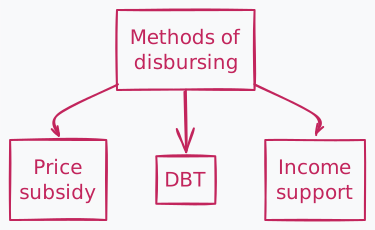
Price Subsidies
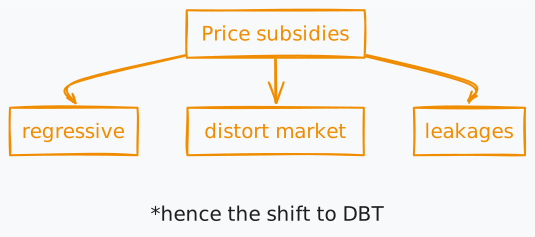
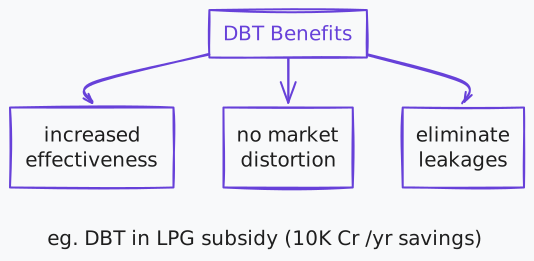
Direct Benefit Transfer
Income Support
- purchase by poor person not needed
- market not distorted (eg. PM Kisan)
Concerns with income support
- reduced incentive to work? (not really)
- moral hazard, lazy ppl, reduced labour supply
- promote vices??
- alcohol, tobacco
Fuel Subsidy
- Petrol & Diesel: deregulated in 2002, being sold on mkt prices
- LPG: Thru DBT (upto 12 cylinders per household)
- Kerosene: removed (to phase out usage of Kerosene)
- switch to cleaner fuels - electricity, LPG
- schemes - Saubhagya, Ujjwala
- states+ut are kerosene free 🔥
Fertilizer Subsidy
Major Fertilizers
The four major fertilizers consumed in India are Urea, Diammonium Phosphate (DAP), Muriate of Potash (MoP) and Complex Fertilizers.
Urea prices are regulated/fixed by the Govt, but the prices of DAP, MoP and Complex Fertilizers have been deregulated (market driven).
- Retention Pricing Scheme: 12% RoI (fixed) for fertilizer manufacturer and sell fertilizer at govt notified prices. But had drawbacks:
- companies inflated costs corruption
- no motivation to innovate, be efficient or reduce costs
Urea Subsidy
- Under the New Urea Policy 2015
- pooling of gas: provide Re-Liquefied Natural Gas(RLNG) at uniform prices to all connected urea plants
- 3 categories based on energy norms
- fixed subsidy for each category
- thus incentive to be efficient and get more subsidy
Benefits of new urea subsidy
- 2MT/yr extra production reduced import dependency
- energy efficiency due to group based norms
- ultimately reduce govt subsidy burden
- reduced carbon footprints
- globally more competive
From May 2015, Neem coated Urea mandatory.
- Less qty, higher yield, reduced underground water contamination
- not fit for industrial use (hence diversions avoided)
- minor price increase (+14INR/bag)
Issues with urea subsidy
- stagnant domestic production: 30 manufacturing companies, 3 import companies
- no new capacity addition in 17 years (25MT capacity)
- consumption increased to 33MT ( 8MT import)
- limited availability of domestic gas (imported gas costly)
Government intervention
- Urea MRP set
- only 3 companies allowed to import (canalisation)
- about half of fertilizer mvmt is directed i.e. govt tells companies how much to import & where to sell
- Results
- market distortion
- leakages
- less availability for small formers
- under pricing
- inefficiennt consumption
Nano Urea (the only nano fertilizer approved in India)
- dev/patent by IFFCO
- declared essential commodity
- FCO promulgated under Section 3 of Essential Commodities Act 1955
Benefits of Nano Urea
- litre of nano urea can replace atleast 50kg urea
- no nano urea subsidy
- sprayed on leaves, enters thru stomata
- 4% nitrogen by volume
- efficiency 85-90% (compared to 25% of conventional urea)
- un-utilized nitrogen stored in plant vacuole and used later
- small size (20-50mm) increases availability by 80%
DAP, MoP, CF Subsidy
- Nutrient based Subsidy (since 2010)
- fixed by govt, not varying by market prices
DBT in fertilizer subsidy
- impl. Jan 2018
- farmers buy at subsidized prices
- companies receive DBT only after sale of urea at Point of Sale (PoS)
Reforms in Fertilizer Subsidy
- transfer 5k - 6k per farmer annually in lieu of fertilizer subsidies
- become self reliant in fertilizer production
- implement NBS model for urea also
- develop alternative sources of nutrient for plants i.e. non chemical fertilizers
- improve fertilizer efficiency through need based use
- eg. Nano Urea developed by IFFCO
Important Recent Schemes by Ministry of Chemical and Fertilizers
- PM Kisa Samruddhi Kendra
- 600 Kendras
- provides
- agri inputs
- testing facilities
- generate awareness
- info abt govt schemes
- regular capacity buliding
- PM Bhartiya Jan Urvarak Pari Yojna
- One Nation One Fertilizer
- uniformity in fertilizer brands
- Bharat Urea, DAP, MoP, RPK
- farmer gets rid of all kinds of confusion about quality of fertilizer and its availability
Food Subsidy
Food Corporation of India
- set up via Food Corporations Act 1964
- objective of food policy
- effective price support operations for safeguarding farmer interests
- distribution of food grains through PDS
- maintaining safety level of operational & buffer stocks
Ensures effective market intervention, keeps prices under check.
Major functions
- Procurement: open ended, at MSP at mandis
- Storage & Contract
- network of storage depots all over india (silo, godowns, cover and plinth)
- construction of godowns in PPP under Private Entrepreneurs Guarantee
- also approved action plan w/ construction of steel silos (100L MT capacity) (PPP)
- Moving & Transportation: food grains procured from state w/ surplus to states with deficit
- Buffer Stocks
- to feed TPDS & other schemes
- ensure food security when production low
- stability prices during production shortfall via open market sales
- approx 25MT buffer stock
India is food surplus. FCI is forced to buy all grains (open ended). Need to incentivize diversification. Farmers are deriving signals from govt policies instead of market which is wrong.
PDS
refer: Public Distribution System
National Food Security Act 2013
- earlier TPDS; now converted to NFSA
- applicable to 75% rural population, 50% urban
- 2 categories
- Antyodaya Anna Yojna: 35kg/mo per family
- Priority households: 5kg/person/mo
- identification o households: rules by CG, on ground identification by SG
- only for 2023: foodgrains provided for free under NFSA
Additional NFSA Benefits
- pregnant, lactating mothers: free meal during pregnancy & 6 months post childbirth thru Aganwadi and Rs 6K in installments
- Children 6mo-6yr: free meal at local Anganwadi
- Children 6yr-14yr: mid day meal
Salient Features
- Women empowerment
- eldest woman ( 18yr) in every household shall be head for purpose of ration cards
- Grievance Redressal Mechanism
- call centre, nodal officers
- every SG constitute State Food Commission for monitoring & review of this act
- chairman & 5 other members
- Obligations of CG, SG
- SG delivers grains from centre to state
- CG provides assistance in handling of food grains, expenditure for intra state movement
- SG delivers grains from centre to state
- Misc.
- this scheme shall not preclude CG/SG from formulating other feed based welfare schemes
- SG may make food or nutrient based plans
One Nation One Ration Card
- nationwide portability of ration cards under NFSA
- allows migrant workers to buy food grains from anywhere in country (FPS)
- digitization, Aadhar, PoS used
Challenges in NFSA
- inclusion/exclusion error
- lack of choice in terms of food grains
- more focus on calories, less on nutrition
- unsustainable food subsidy bill
- poor integration of tech
Improved outcomes by NFSA
- undernourishment; 22% (in 2010) 15% (in 2020)
- from FAO’s State of Food Security & Nutritien 2021
- stunted children reduced from 38% 35%