Questions
Analyze the constitutional provisions related to the declaration of a national emergency and assess how the suspension of Fundamental Rights during emergencies strikes a balance between national security and individual liberties.
Examine the interplay between the President’s power to proclaim a state of emergency and the constitutional safeguards intended to prevent its misuse, particularly in light of the basic structure doctrine.
Evaluate the impact of a national emergency on the federal structure of the Indian polity, considering how it temporarily alters the distribution of powers between the center and the states and its implications for cooperative federalism.
Assess the role of the President, the Council of Ministers, and Parliament during a national emergency, analyzing the constitutional checks and balances in place to prevent authoritarianism and uphold democratic principles.
Explore the linkage between the proclamation of a state of emergency and the suspension of the right to constitutional remedies, and analyze how this suspension affects the judicial review of executive actions during emergencies.
Examine the constitutional provisions related to a state of emergency arising due to the failure of constitutional machinery in a state and assess the implications for the relationship between the center and the states.
Analyze the impact of a financial emergency on the fiscal policies of the country and its repercussions on the economy, considering the constitutional provisions that empower the President to declare such an emergency.
About
- attacks Fundamental Rights and Federalism
- use only in exceptional cases
- provisions
- 360: Financial Emergency (FE)
- 352: Proclamation of Emergency (PoE)
- 356: Failure of Constitutional Machinery (FoCM)
Financial Emergency (360)
- only upon written advice of CoM headed by PM
- US: observe fin prudence
- US:🔻sal of state officers
- U:🔻sal of U officers
Safeguards
- Parl consent via resolution necessary within 2 month
- never actually invoked though
Proclamation of Emergency (352)
- security of India or part at threat due to
- armed rebellion (added via 44th CAA 1978)
- war
- external aggression
- ⭐ actual occurrence not necessary; just an imminent threat sufficient reason (as per 44th CAA 1978)
Effects
Centre State Relations
- U: exec dirn
- Parl may legis over State subj (as per need)
- US: fin arrangement may be modified / suspended
Fundamental Rights
- automatic suspension of FR 19 by Article 358
- only if external grounds (as per 44th CAA 1978)
- Validity of 19-violative legis only till PoE (as per 44th CAA 1978)
- 359: Prez may by order suspend enforcement of FR
- except 20, 21 (as per 44th CAA 1978)
Safeguards
- Parl approval within 1mo with spl majority (as per 44th CAA 1978)
- Duration 6mo at a time
- written advice of CoM mandatory (as per 44th CAA 1978)
- Spl sitting of HoP necessary within 14 days
- if in writing intend to move motion against PoE and approved, then PoE discontd.
Failure of Constitutional Machinery (356)
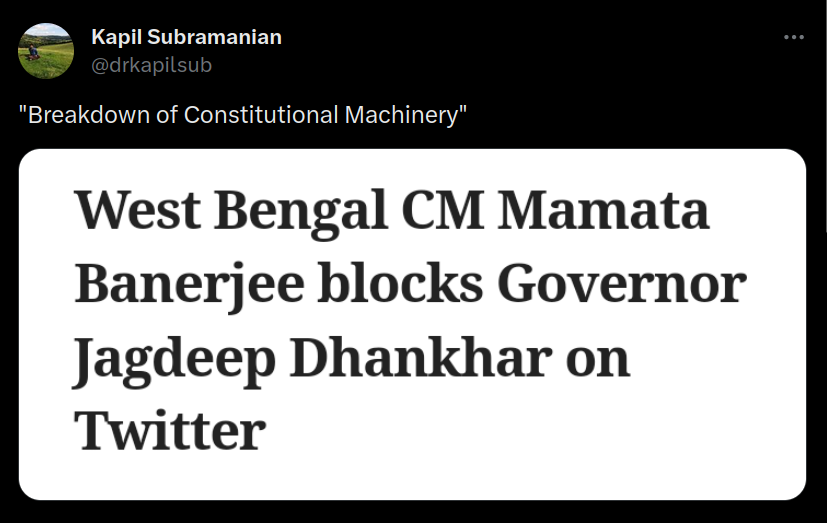
Conditions
- gross violation of constitutional provisions
- hung assembly
- state govt in secessionist acts
- Article 355: duty of the Union to protect every State against external aggression and internal disturbance and to ensure that the Government of every State is carried on in accordance with the provisions of the Constitution
Effects
- CoM dismissed: Prez gets exec pwr
- SLA suspended: Prez gets legis pwr
- Prez can make other orders for effective implementation of 356
Safeguards
- Parl approval: both houses 2mo, spl aj
- 6mo duration (+6 upon approval)
Issues
- misuse and overuse
- borrowed from GoI Acts 1935
- vague, subjective, prone to misuse
- Dr. BR Ambedkar called it a “dead letter”
- but has become “dreaded letter”
SR Bommai Case
- JR of invocation allowed
- exercise mustn’t be arbitrary
- SC may restore CoM, SLA if misuse of FoCM