2015 Pew Research Center Study
8 in 10 Indians said religion is very important
Religious Communities
- India officially called secular via 42nd CAA 1976
- Fundamental Rights (Article 25-28)
- Parsis
- enterprising, significant representation in industrial sector
- dwindling numbers
Communalism
2017 Pew Research Center Study
- 37% call communal relations very big problem
- 31% call it moderately big problem
- origin: Morley Minto Reforms (ICA 1909) (separate electorate)
- communal tension
- Shah Bano Judgement
- Ram Janmbhoomi Movement
- Anti Sikh Riot 1984
- modern edu, reform mvmt imp
- Islam remains less reformed
- only few reformers eg Sir Syed Ahmad Khan
- post independence, govt focus on comforting minorities (not civic reforms)
Secularism
MN Srinivas on secularism
What was previously regarded as religious is ceasing to be such.
Indian Secularism
Rajiv Bhargava on Indian secularism
Principled distance between religion and politics.
- liberal plural view: by modern nationalist
- separation of religion and other institutions
- orthodox plural view: MG, SDS, Ramakrishna Mission
- Constitution has liberal plural view
Cultural Pluralism
Arrangement in a society wherein multiple smaller cultures assimilate in mainstream society but also maintain their uniqueness w/o being homogenized by dominant culture.
As a humanist idea
- emphasis on humans, irrespective of religion, race, caste
- apathetic towards god
- supporters of morality, but not religious morality
- both support materialism, rational thinking, scientific outlook
Emergence of secularism
- Humanists extreme in rejecting all God-related discussion as unjustified
- we needed way to integrate scientific knowledge & democratic social values w/ institutions of religion
- secularism better as in accordance w/ norms of civilized society
Problems of Religious Minorities
- M Gandhi: mixing religion & politics adverse effects on socio-eco dev of minorities
- 2011 census: minorities are 19%
- based on threat perception, cultural & socio-eco dev level
- majoritarianism (democracy moment!)
Common Problems
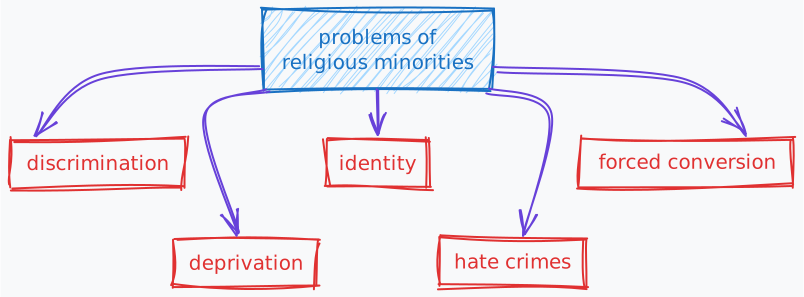
- threat to identity
- physical security (riots)
- politicization of majority - minority relationship
- low representation in public jobs, armed forces
- psychological insecurity despite enactment of laws
- due to historical factors
- Indian Education Commission 1960s: language related problems
JL Nehru
Test of Indian secularism lies not in what the majority thinks, but how the minorities feel.
Scapegoat Theory
When groups face problems, they unfairly blame / target a subordinate group leading to discrimination, prejudice.
- Hitler blamed Jews for Germany’s socio-eco problems
- Immigrants frequently been scapegoat in US
Muslims
- lagging behind in human dev parameters
- Sachhar Committee 2006: 3 fold problem of identity, security, equity
- highest incidence of stunted children
- 25% children never been to school
- 14% of population (2011 census) but 2% representation in PG courses
- 4% representation in armed forces
- only 27% in regular employment
- stereotyping due to spread of Islamic fundamentalism
- Ghettoization
Christians
- missionaries accused of forced conversions
- murder of Grahm Stein
- many Christian are tribals
- socio-eco, pol, cultural discrimination
- dalit christians
- reservations non uniform (eg. not for dalit christians)
Sikhs
- Mughal Rule religious persecution
- identity crisis after death of Maharaja Ranjit Singh
- shrines under control of corrupt, mean Mahants
- hardships post independence
- punjab bifurcated
- fertile agri land of Indus + religious shrines in Pakistan
- extremist elements, militancy (Khalistan)
- Anti Sikh Riots 1984
- however, no strong extremism in community
- poor sex ratio despite relative affluence
- agri unprofitable
- Farmer protest 2020-21
Parsis
- arrived in India after Persia faced Islamic invasions
- helped in religious reforms, industrial dev during colonial period
- put indian industries on global map
- economy sound, edu avanced
- rigid religious beliefs
- no outsiders (Purity of Parsi blood)
- no inter caste marriage
- youth unmarried or less children
- 97% literacy, 1050 sex ratio
- Roy & Unisa: childlessness, migration are contributors to dwindling numbers
- high interbreeding genetic issues
Jains
- mercantile community, clone knit
- Jains part of hindu community as per civic law
- they don’t like
- harmonious bonds w/ Mughal rulers through spiritual leaders & affluent traders
- good rel. w/ brits also
- regimented food habits
Minority Welfare
Don’t ignore
- Bangladesh formation 1971 cuz Pakistan neglected them
- similar attempts in Khalistan Movement (unsuccessful)
- Sri Lanka - Sinhalese vs Tamils
- frustrated youth of minority groups turn to nefarious anti social activities
Government Initiatives
- Article 29 and Article 30
- FYP have had spl. provisions
- National Minorities Development & Finance Corporation (NMDFC) 1994: PSU; loans at concessional interest rates for self employment & eco dev to backward sections of minorities
- Multi Sectoral Development Progrem 2008: bridge development deficits faced by minorities
- creation of socio-eco infra for basic assets
- Jiyo Parsi Scheme 2013
- Nayi Roshini: leadership development among minority women
- Upgrading Skills & Training in Traditional Arts Crafts for Development (USTTAD) 2015: promoting traditional skills among artisans of minority groups
- Nayi Manzil: impart edu & skill building among youth from minority communities