Land Boundary Agreement
- 4096km common boundary
- longest land boundary b/w India and a neighboring country
Land Exchange
- transfer of 111 Indian enclaves to Bangladesh
- in return, 51 enclaves transferred to India
Recent News
- 1 Aug 2022: 8th anniversary of India Bangladesh Land Boundary
- Nov 2021: Union Home Minister announced plans to connect NE states to Bangladesh by road & railways within a year or two
- citing historic Land Boundary Agreement
Significance of Border Management
- secure long pending border issues b/w India & Bangladesh
- check on human trafficking
- reduce infiltration
- curb illegal migration
- improve condition of satellite ppl living in enclaves
- improve connectivity w/ Bangladesh & thru it to SE Asia
- improve access to NE states and enable improvement of economic conditions of ppl living in these enclaves
Background
- Indira-Mujib Pact of 1972.
- 1974: Initiatives regarding the border.
- 119th Amendment Bill 2013.
- 2015: Implementation of the Land Boundary Agreement.
Security Cooperation
- massive cooperation of military resources since coming up of Awami League in Bangladesh
- Border incidences supposedly reduced to almost zero
Conversion of intl. boundary along Kushiyara River into fixed boundary
Facilitation of border fencing
Connectivity
- Bangladesh Bhutan India Nepal (BBIN) Motor Vehiccle Agreement (MVA)
Recent News
- WB report, “Connecting to Thrive: Challenges and Opportunities of Transport Integration in SE Asia highlighted potential of seamless transport connectivity b/w India & Bangladesh
- report suggested that such connectivity could boost national income by upto 17% in Bangladesh and 8% in India
About BBIN
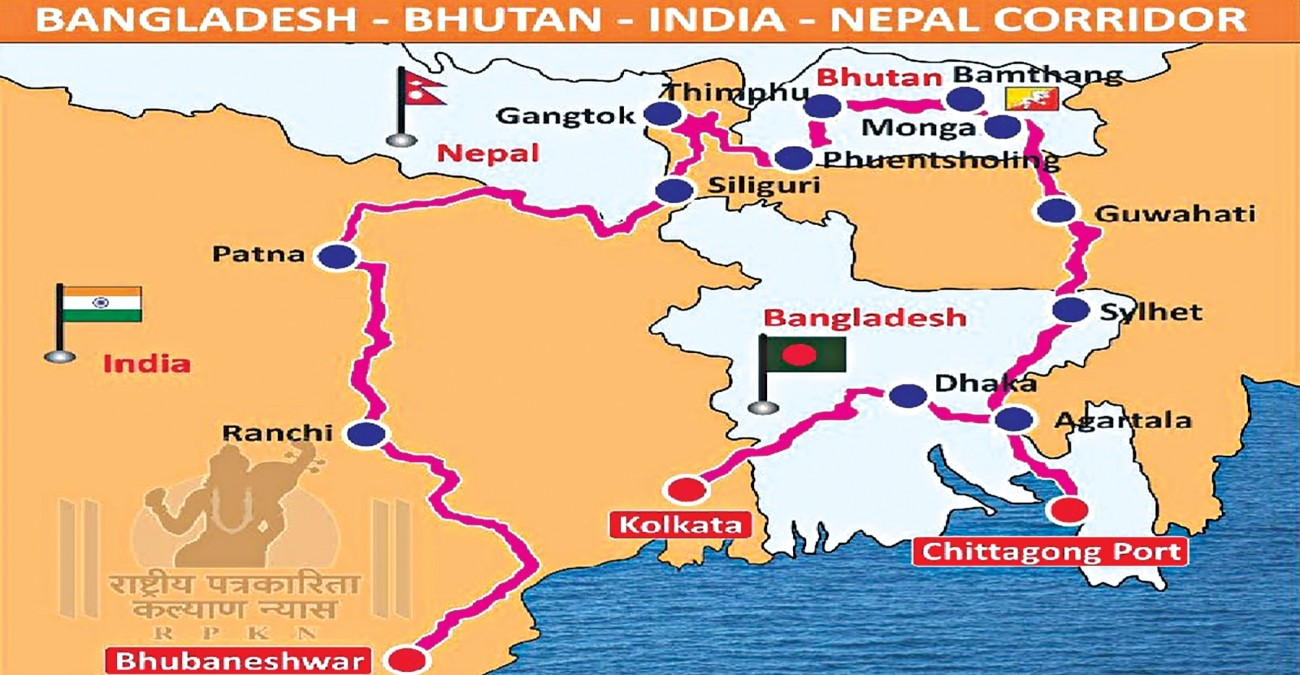
- signed on 15th Jun 2015 in Thimphu, Bhutan
- aims to facilitate unrestricted cross border mvmt of cargo, passenger and personal vehicles b/w BBIN countries
Advantages of BBIN
- improving trade in goods cargo and services
- seamless transfer of people
- P2P contact lead to decrease in deficit of trust
- tousism
- imp. connectivity initiative which will have strong security implications
- regional alternative to BRI in the regions
Why did Bhutan opt out of from BBIN MVA?
- env degradation
- insecurity among local truckers in Bhutan
- Bhutan’s upper house has not ratified the BBIN MVA
- in Mar 2022, participating countries met to actualize the long pending connectivity aspirations
- Bhutan who has opted out was an observer particpant
Protocol on Inland Water Transit and Trade (PIWTT)
Recent News (May 2020)
- second addendum to PIWTT was signed
Historical Context
- first signed 1972
- last renewed in 2015, for 5 yrs, with automatic renewal provision for addl. 5 yrs
Cargo Sharing
- 50-50 cargo sharing allowed by Indian & Bangladesh vessels
Protocol updates
- includes new Indo Bangladesh Protocol (IBP) routes, inc from 8 to 10
- inclusion of Sonamura Daudkandi stretch of Gumti river
- operationalization of the Rajshahi - Dhulian - Rajshahi route and its extension up to Aricha, Bangladesh
Declaration of New Ports of Call
Previous configuration
- 6 ports of call each in India & Bangladesh under the protocol
Changes
- 5 new ports of call introduced on both sides
- 2 ports of call were extended for enhanced connectivity
Bangladesh China India Myanmar Corridor (BCIM)
Recent Development
- India’s decision to abstain from Belt and Road Forum resulted in exclusion of BCIM Economic Corridor from projects covered by China led Belt and Road Initiative (BRI) umbrella
Exclusive reason
- non participation in BRF led to BCIM Economic Corridor being left out of the broader BRI projects
Importance of BCIM
- BCIM Economic Corridor aims to connect Kolkata with Kunming, capital of Yunnan province
- reduce trade bottleneck
- reduce transportation costs & will make prices of G&S consumer friendly
- increase cross boundary transportation b/w G&S
- increase cross boundary mvmt of ppl
- increase prospects of infrastructural dev & many energy projects
- lead to thriving economic belt
- tourism
- increase income level
- poverty alleviation
- lead to grid development of the regions