Meaning
Most commonly accepted medium of exchange i.e. any object that is generally accepted as means of payment. Currency in form of notes or coins in one type of money.
Barter System Problems
- double coincidence of wants
- difficult to carry forward wealth
- absence of standard unit of account
Functions of Money
- acts as medium of exchange
- common measure of value
- store of value
- standard for deferred payment
Types of Money
Full Bodied Money
- face value equivalent to intrinsic value
- embedded in currency itself
Token money
- value as money more than value as commodity
Representative Full Bodied Paper Money (convertible money)
- paper money that is issued against an equivalent amount of gold/silver by issuing authority
- this paper money can be exchanged with equivalent amount of gold or silver from central bank
- this called convertible money as it can be converted to full bodied money
Inconvertible Money
- paper money that can’t be converted into equivalent amount of gold or silver
- eg RBI has no obligation to convert paper money to gold or silver
Fiat System
- fiat means order
- serves as money on order of govt
- issued w/o any backing of gold or silver
- no obligation on any person to accept this money as medium of exchange
- no legal action can be initiated if person refuses to accept
Legal Tender
- compulsory to accept legal tender for settlement of monetary obligation
- money recognized by law of land as valid payment of det
- RBI Act 1934: gives central bank the sole right to issues bank notes and states that every bank note shall be legal tender at any place in India
- govt can issue fiat money and declare it to be legal tender
- Coinage Act 2011: coins issued are also legal tender
- Currency Ordinance 1940: One rupee note issued by Ministry of Finance is legal tender
Types of legal tender
- Limited Legal Tender Money: compulsory to accept this as a means of payment only upto a certain limit
- 50p coins can’t be used to make payment beyond Rs. 10
- Unlimited Legal Tender Money: can be offered as payment of dues of any sizes eg currency notes
Fiduciary Money (Non Legal Tender)
- accepted on basis of trust between payee and payer eg cheque
- one is not bound to accept it legally
Near Money (Quasi money)
- highly liquid assets that can be quickly converted to cash
- fixed deposit, demand draft
Creation of Money 🤑
- Currency issued by RBI under RBI Act 1934
- assets should match liabilities
Assets & Liabilities
- Assets
- G-Sec thru which govt borrows money from RBI & returns principle & interests
- gold
- foreign securities
- one rupee notes, coins which RBI circulates as an agent of govt
- Liabilities
- all currency notes except one rupee note, coins
- currency held by public
- currency held by banks in vault cash
- other deposits in RBI
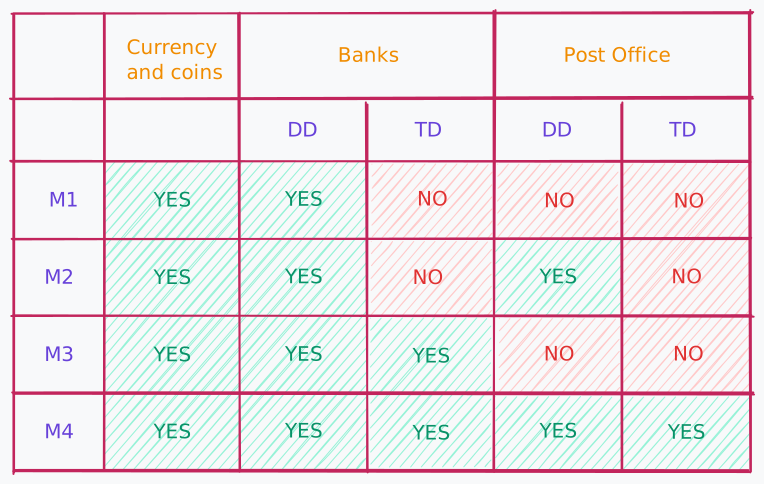
- M1 = CU + DD of banks + other deposits with RBI
- M2 = M1 + Post office saving deposits (DD)
- M3 = M1 + Time deposits of the banks+ other deposits with RBI
- = CU+ DD + TD + other deposits with RBI
- = CU + NDTL + other deposits with RBI
- M4 = M3 + total post office deposits
- In terms of liquidity, M1 > M2 > M3 > M4
- M1 and M2 are Narrow Money.
- M3 and M4 are known as broad money.
Money Multiplier 📈
Amount of money banks are able to create in form of deposits
- they create credit that is in far excess of initial deposits
- Deposit creation comes to an end when total reserves become equal to initial deposits.
Other Important Terms
Currency Deposit Ratio
- if CDR = 1
- for every Rs.100 person earns, he deposits 50 in bank and keeps 50 in wallet
Slippage Ratio
Rate at which good loans are turning bad
- or the rate at which standards assets are turning out to become NPA
- credit cost is the amount bank expects to lose due to credit risk
Reserve Money (M0)
M0 is the total liabilities of RBI.
- called monetary base
- denotes money of RBI
- includes
- currency in circulation
- bank deposits w/ RBI
- other deposits w/ RBI