Early sociological records
- Republic by Plato
- De Officiis by Cicero
- Arthashastra by Kautilya
The Europe Connection
Enlightenment (17th - 18th century)
Philosophy
Positioned human being as the central figure of the universe, with rational thought at its core.
Irving Zeitlin
Early socio dev as a reaction to the Enlightenment.
- secular, scientific, humanistic attitudes
- rationalism, empiricism, change orientation
- rational & critical thinking
- Montesquieu, Rousseau, Darwin, French Revolution
- French sociologists: Alexis de Tocqueville, Clause Saint-Simon, Auguste Comte, Spencer, Emile Durkheim
- Comte first to use the word Sociology
- developed scientific view (positivism)
- Comte first to use the word Sociology
- French Revolution: liberty, equality, fraternity
Industrial Revolution
- massive production of goods & services
- replaced family as an institution
- see also Industrial Society and Family Life
- factory system, emergence of =working class=
- don’t know each other personally
- bureaucracy
French Revolution 1789
- liberty, equality, fraternity
- even Indian society influenced
- Feudalism altered
- older 3 estates w/ diff status, privileges & restrictions dismantled & got uniformity in social structure
Commercial Revolution (15th century +)
- large scale, organized
- Portugal, Spain, Holland, England
- overseas discoveries, conquests
- eg. Christopher Columbus
- discovery of new societies
- change in market economies led to change in social relationships
Scientific Revolution
- intellectuals questioned corrupt practices of the Church
- eg. Martin Luther
- propagated scientific edu
- imbibed spirit of science
- questioned extravagant religious rituals developed by clergies
- inventions changed lifestyle and in turn social relationships
- related article on Penn Today: How the appliance boom moved more women into the workforce
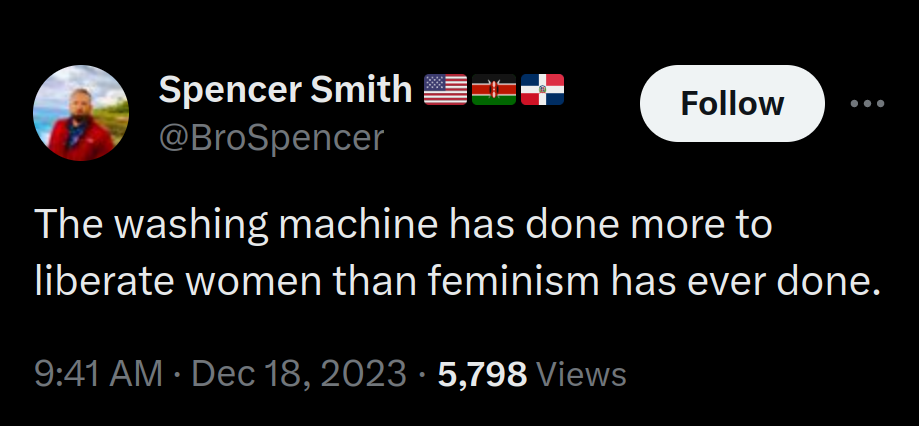 ☝️ only some light humor; not for exam
Comparisons
Sociology vs Economics
Alfred Marshal
Eco study of how man earns & spends money
- eco activity also social activity
- methods of earning money guided by social norms / values
- eg robbery not legitimate
- consumption behaviour affected by social / cultural values
- methods of earning money guided by social norms / values
- Pierre Bourdieu: economist takes into account even the cost of externalities
- suicide, pollution, crimes etc
- Marxist: economic behaviour of man a key to understanding social behaviour of man
- Durkheim: rejected Division of Labour
- Recent studies by Gunnar Myrdal, Raymond Aron etc used in both socio & eco
- Economic Sociology
- gender budgeting, feminist economics
| Economics | Sociology |
|---|---|
| narrow scope, related to production activities | wider scope, studies all aspects of human activity |
| emphasis on rel b/w pure economic variables | study prod enterprise as a social org (eg role of caste system in economy) |
| framework of ownership and relationship to means of production | crit eco theories reductionist, ignoring social factors influencing eco behaviour |
| more systematized, scientific. Has laws which predict with fair accuracy | no technical solution. Only encouragement of a critical analytical perspective |
| more scope of building theory, laws eg demand supply | laws less universal |
Sociology vs Psychology
- JS Mill: all laws are derived from laws of mind
- Sigmund Freud: imptance to inheritance over environment
- sociology is merely an extension of social psychology
- Durkheim: theory of suicide from sociological pov
- Ginsberg: many sociological generalizations can be more firmly established by relating them to psychological laws
- Weber: better sociological explanations by enriching with underlying meanings
- Gerth & Mills: study of social psychology is interplay between individual character & social structure
| Psychology | Sociology |
|---|---|
| study of individual human personality | study of individual + society |
| man’s experience, behaviour, basic instincts, sympathy, imitations, passions | social institutions, inter relationships, family, individual, religion, power |
| limited scope (man’s mental activity + basic behaviour) | general study of society, wider scope |
| more scientific, greater experimentation scope, psychological laboratories | multiple perspectives and claim of being scientific is contested |
Sociology vs History
GE Howard
History is past Sociology; Sociology is present History.
- subject matter of socio & history overlap
- historians provide the material sociologists use
- sociologists get crucial info abt past
- Karl Marx, Durkheim used lot of historical data in their sociological discourse
- Radcliffe Brown: socio is nomothetic while history is idiographic
- historian describes unique events
- sociologist describes generalizations
- coming closer as now history also concerned w/ “how” of events
- history is no longer purely descriptive
| History | Sociology |
|---|---|
| study the past | study contemporary past & present |
| delineate actual events, how things happened | establishing casual rel. thru detached observations |
| descriptive | normative eg. feminist, marxist persp. |
| study concrete details w/ obj discussion of real events | generalize events to study phenomenon (not events) |
| looks at events from framework of time | looks at events, institutions from pov of nature of rel. involved |
Sociology vs Political Science
- policies affect social parameters
- eg China 1 child policy
- Beti Bachao, Beti Padhao in India
- American policies promotes values of openness & individual freedom
- Pakistani policies advocate for religious codes
- MN Srinivas: Vote Bank Politics
- CW Mills: Power elite
- Marx: pol institutions & behaviours closely linked w/ eco system & social classes
- political parties, elite classes, voting behaviour, bureaucracy, political ideology
| Political Science | Sociology |
|---|---|
| restricted to study of state & power | wider, study of all aspects of society |
| subject matter better codified | more open ended |
| attn. to processes within govt & rel. w/ ppl | interrelationships among a wide set of institutions incl. govt |
| provide laws that affect welfare of masses | data & basis for these laws & policies (eg. caste, kinship, demographics) |
Sociology vs Anthropology
- study same matter: man
- time and cultural elements separate them
- high convergence
- small primitive units which anthropologists study are fast disappearing
- MN Srinivas: distinction b/w industrialized & non industrialized society blurred due to interconnected economies
| Anthropology | Sociology |
|---|---|
| curiosity of western scholars in primitive societies in non western countries | philosophy of history, political thought, +ve sciences in light of challenges posed by modernity and industrial societies |
| describe, analyze in clinically neutral terms (they are outsiders, not involved) | loaded w/ values, conclusions have ethical considerations |
| study simple societies in all aspects, without much historical records | study part of existing society (eg family, mobility) in context of historical records |
| live in community to observe and record | rely on statistics, questionnaires and give formal analysis |
| study physical aspects related to evolution, biology | focus on cultural, social aspects |
Sociology vs Common Sense
Peter Berger
The fascination of Sociology lies in the fact that its perspective makes us see, in a new light, the very world in which we have lived our lives.
- Common Sense: routine knowledge ppl have of their everyday world and acitivties
- based on naturalistic, individualistic explanations
- prejudices, biases
- not necessarily false, but is unexamined, unreflected, for granted
- helps in hypothesis buliding
- Sociologist is a sceptic however
- looking beyond what meets the eye
- gives deeper insight into our very own routine lives which are ignored by common sense
| Common Sense | Sociology |
|---|---|
| based on reinforced traditions | challenges these traditions |
| assumption based | evidence based |
| no empirical testing | has empirical orientation |
| not coherent or consistent | objective knowledge |
| very personal and individualistic | generalization & theory buliding |
| promotes status quoism | change oriented |
| unreflective | open to debates |
| personal judgement | has body of knowledge, methods, data |