Facts
- Marginal farmers have largest number of holdings (68%) but not proportional amt of land
- Small and marginal farmers are 86% which operate on 47% of the total agri-area
Agriculture Census
Agri in india
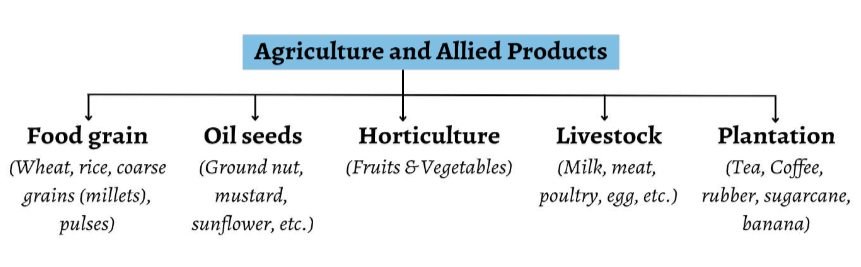
- imp for poverty alleviation and employment generation
- share of agri in GDP declining (50% in 1950-51 to 16% in 2019-20)
- share of agri to employment declining (70% 42%)
Backdrops
- 2 wars
- China - 1962
- Pakistan - 1965
- 2 droughts: 1965-66
- not able to channelize resources in rural investments → food crisis
- food grain production and yield decline
- food grain import increased
- Cold War → food aid used to twist arms of recipient countries and seek compliance
- US shipment once abruptly stopped for 48 hours at height of drought
Green Revolution
- M.S. Swaminathan
- Wheat, rice, tubewells
refer: Green Revolution
White Revolution
- Dr. Verghese Kurien
- milk
refer: White Revolution
Pink Revolution
- poultry sector
refer: Pink Revolution
Minimum Support Price
refer: Minimum Support Price
Pradhan Mantri Annadata Aay Sanrakshan Abhiyan
- Price Support Scheme
- phy procurement of pulses, oilseeds done by central nodal agencies
- Price Deficiency Payment Scheme
- cover all oilseeds for which MSP notified
- payments into registered bank acc
- Pilot of Private Procurement & Stockist Scheme
- Pvt agency shall procure commodity at MSP in notified markets during notified period from registered farmers
refer: Pradhan Mantri Annadata Aay Sanrakshan Abhiyan
Pradhan Mantri Kisan Samman Nidhi
- income support of Rs. 6k/yr to all eligible farmer families in 3 equal installments
- refer: Pradhan Mantri Kisan Samman Nidhi
Agri Extension Services
- also called rural advisory services
- key input for improving productivity in agri by providing timely advisory services to farmers to adopt best practices, tech, meet with contingencies, market info
Agencies in India
- Dept of Agri and Coop, NABARD: scheme for establishment of agri-clinics, agri business centres, ventures by agri graduates
- ICAR: associated in agri extension activities thru Krishi Vigyan Kendras (KVK) and Institute Village Linkage Program (IVLP) all over the country
- FPO, NGO, Coop sector
National Mission on Agri Extension and Tech (NMAET)
- launched during 12th plan
- 4 sub mission
- Sub Mission on Agri Extension (SMAE): adoption of quality seeds via agri clinics, agri business centers, kisan call centres
- Sub Mission on Seed and Planting Material (SMSP): seed chain from nucleus seed to supply to farmers for sowing. Protection of plant varieties and farmer rights authority (PPV&FRA) to put in place effective system for protection of plant varieties, rights of farmers and plant breeders and to encourage development of new varieties of plants
- Sub Mission on Agri Mechanization (SMAM): Farm power availability and agri productivity; farm mechanization. Cater to small and marginal farmers and where farm power is low
- Sub Mission on Plant Protection and Plant Quarantine (SMPP): keeping crops disease free using scientific and env friendly tech, Integrated Pest Management Custom Hiring Centres: A unit of costly, advanced, bigger farm machinery implements for custom hiring by farmers who cannot afford to purchase high end agri machinery. Govt. through SMAM provides subsidy @40% of project cost to individual farmers up to a cap of Rs. 60L.
Krishi Vigyan Kendra
- GoI thru ICAR - network of 700 KVK
- conduct technology assessment and refinement, knowledge dissemination and provide critical input support for farmers with multidisciplinary approach
- graasroot level institutions for empowering farming community
- part of decentralized planning and implementation to achieve growth in agri and allied sector
Support
- on farm testing to demonstrate location specific agri technologies and prove potential of various crops at farmer’s fields
- need based training programs for farmers, women, rural youth
- awareness about improved agri tech thru extension programs
- critical and quality inputs like seed, planting material, organic products, bio-ferts, livestock, piglet and poultry strains are produced by KVK and made available to farmers.
Farmers Producer Organization
- ensure better income of farmer through an organization of multiple farmers
refer: Farmers Producer Organization
Marketing of Agri Produce
Agri Produce and Marketing Committee (APMC) Act
- first sale forced in mandi
Features
- trader needs licence and shop/ warehouse in mandi to operate there
- price of farmer produce to be discovered thru auctioning
Issues
- wholesalers, retail traders or food processing companies cannot purchase farm produce directly
- mandi charges creating distortion, cascading effect
- mandis located across a state are not integrated; separate licences for each mandi required for trading in separate mandis
Exploitation
- bribes for license → corruption
- auctioning either doesn’t happen or traders form cartel to keep prices artificially low.
- during peak season, traders don’t reduce price for final customer; during lean season, traders don’t pass benefit to farmers
Electronic - National Agriculture Market
- online platform
Benefits
- traders all over india bid for farm produce
- increases choice for farmer
- better price discovery
- promotes scientific storage and mvmt of agri goods
- logistics integrated
refer: Electronic National Agriculture Market (e-NAM)
Model Agri Produce and Livestock Marketing Act 2017
- CG, April 2017, liberalize trade in agri and livestock
- private wholesale markets; direct sale by farmers to bulk buyers
- allow godowns, warehouses and cold storages to act as regulated markets - inc market avenue and create competition
- simpler regulation and licencing structure. Remove disincentives for inter state trade. Lower cess, customs
Benefits
- better deals to farmer
- stable prices for consumer
Contract farming
- agri production carried out acc to agreement b/w buyer and farmer
- quantity, quality, time
- commitment to buy at a later date
Advantage
- guaranteed market outlet to farmer, no uncertainty regarding prices. Often provided with loans in kind
- purchaser has guaranteed supply, quality and timely delivery
Issues
- if one contract party doesn’t follow? Farmers may sell to diff buyer for better price or purchaser downgrading quality to pay less
- buying firms invariably more powerful than farmers, have high bargaining clout
Roadblocks
- most farmers marginal or small
- no incentive for contract farming
- heterogeneity in quality
- consolidate farmers through FPO and self help groups
- on demand side, allow private players to bring new technology and business models
Model Contract Farming Act 2018
- setting up of unbiased state level agency - Contract Farming Authority to carry out assigned mandates
- Registering and Agreement Recording Committee at district / taluka level for registrations of contract
- no rights, ownership or possession to be transferred
- promoting FPO
- making provisions to guide parties to fix pre agreed price for violent market movements
- Contract Farming Facilitation Group at village level to take quick and need based decision relating to production and post production activities
Agri Based Clusters
- geographical concentration of industries which gain advantages through co-location
- Horizontal and Vertical
- advantages for small producer and agribusiness firms
- access to global markets, higher value added production, raise competitive advantage of farmers
- promote co-opetition
- socio-economic development of a given territory. +ve impact on income enhancement, employment generation and well being of workers and entrepreneurs
Challenges
- large no. of small and marginal farmers
- regulatory hurdles like APMC and land leasing
- meeting consumer demands while increasing efficiency and productivity
- need to introduce market driven innovation and new tech
- increasingly stringent env regulations
Examples
- Jute - rural WB
- Bamboo, organic food - NE
- Mega food park - punjab, UK
Agri Infrastructure Fund
- CG, long term debt financing
- 1L-Cr financial support
- interest subvention of upto 3% per annum upto 2Cr
- Credit guarantee coverage
Benefits
- facilitating formal credit to farm and farm processing activities expected to create job opportunities in rural areas
- storage and processing facilities will be created, allowing higher prices to farmers
- reduce wastage, increase processing and value addition
- boost to agri sector, india compete on global stage
- invest in post harvent mgmt solution - warehousing, cold chain, food processing; global presence in organic and fortified foods
Animal husbandry
- estd. of dairy and meat processing and value addition infra
- beneficiaries - FPO, MSME, Not for Profits, PVT companies, Individual entrepreneurs
- 90% money by scheduled bank, 10% by beneficiary
- 3% interest subvention by CG
- 2yr moratorium period; 6yr repayment preriod
Pradhan Mantri Fasal Bima Yojna
- cover post harvest loss
- seasonal conditions
- calamities
refer: Pradhan Mantri Fasal Bima Yojna
Doubling Farmers’ Income
Dalwai Committee recommendations
- Improvement in productivity of crops: enhancing access to irrigation and tech advancements
- Improvement in livestock productivity:
- Increase in cropping intensity: short duration crops after rabi and kharif
- Resource use efficiency:
- Diversification towards high value crops
- Shifting cultivators from farm to non farm occupations: high underemployment - 43% of labour force contributing 17% of GDP
Agri Export Polity 2018
- double agri exports
- diversify export baskets
- promote novel and traditional agre product exports
refer: Agri Export Policy 2018