- foundation of conflict perspective
Historical Materialism
Karl Marx
History is a process of man’s self creation.
- materialistic conception of history
- conception of society in terms of evolutions from one stage to another (Marx refers to it as modes of production)
- material / economic factors have a pivotal role in historical change
- inquiry into nature of relations b/w man and man
- necessary to understand history to understand society
Why "materialistic"?
- conception of society based upon materialistic factors; understood in terms of production
- understanding of change is based upon changing material conditions & not ideas
2 aspects of theory of historical materialism
- materialistic conception of society is in terms of economic infra & social superstructure
- understands historical evolution process in terms of a dialectic process
Production
Karl Marx
In order to survive, man must produce.
- man perpetually dissatisfied one need satisfied, then new created production continues history proceeds
2 types of relations of production
Relation between man and man
- associations with individuals form to undertake production
- lead to stratification, formulation of classes
- haves - own production, earn profits
- have nots - sell labour to earn wages
- antagonistic cooperation
Relation between man and things
- nature of ‘ownership’ and ‘non ownership’
- haves - own production
- have nots - own their labour
According to Marx, these relations are dynamic. Antagonism keeps on increasing resulting into conflict between the two classes. Similarly, the relationship between man and things also keeps on changing.
- such a degree of exploitation that man loses control over his own labour
- social relationships determine existence of man and not his own will
Forces of Production
FoP
Help in transforming things available in nature to things which can be exchanged in market.
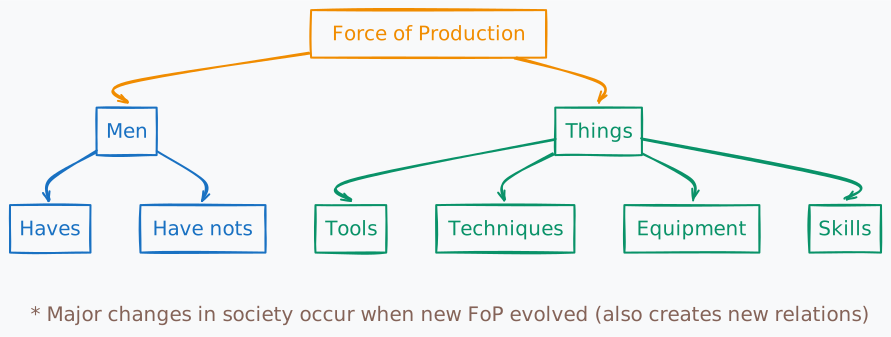
- a contradiction b/w older & new FoP resolved by replacement of older mode of production being replaced by newer one
- Centrality of one major thing in every society
- feudal: land
- capitalist: capital
Both forces & relations of production change continuously and together the two constitute economic base or infrastructure of society.
Systemic View

- Economic infrastructure: forces, relation incl. classes, tools, techniques
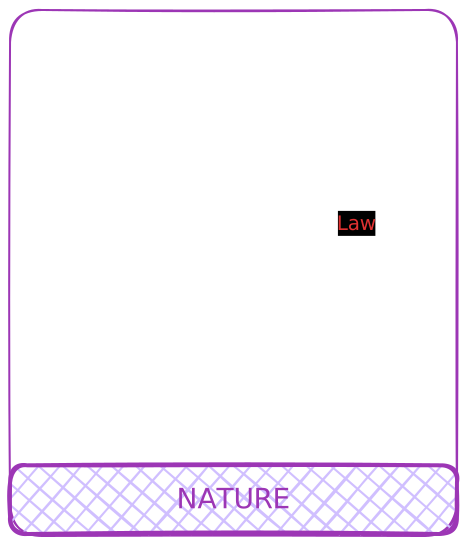
- Social superstructure: culture, law, state, family, religion, education
Economic infrastructure shapes social superstructure which in turns helps in functioning of economic infrastructure.
Criticism of Materialistic Conception of History
- reductionist, overemphasis on material factors
- Karl Popper: termed him economic reductionism
- over emphasis on conflict, ignored social order
- Coser, Simmel: conflict has its own functions
- conflict attributed to rel. w/ eco infra, but Dahrendorf says differential authority structure is root cause of conflict
- focuses primarily on macro evolutionary aspect, ignored micro reality of social life
Mode of Production Theory
- term used for particular social formation or society
6 modes
4 are historical, 2 are futuristic
- Primitive Communism: equal access to FoP. Abundant food, low population, communal structure
- Ancient Slave Mode of Production: some men have control over skills & tools and other subordinate to him
- Feudalism: land central; Serfs free, but forced to cultivate on feudal lord land, pay tax
- Capitalism: capital central; proletariat & bourgeiose, workers lose control over labour, feel alienated, class conflict
- Socialism: transitory MoP; proletariat topples bourgeiose and controls FoP (dictatorship of proletariat)
- Advanced Communism: FoP communally owned, workers renounce rule, everyone carries out his own creative pursuit, no class
Criticism of MoP Theory
- futuristic communist utopia never arrived even in communist countries
- proles never took lead in toppling capitalism
- Idea of Asiatic MoP runs counter to his MoP thesis
- narrow empiricism, reductionist approach
- limited analysis
- ignored consumption related aspects
- ignored feminist dimension of production
Marx on Individual
- man perpetually dissatisfied, creates new needs once existing satisfied
- but man driven by structure of society and is subordinate to it
There are 2 essential aspects of human nature.
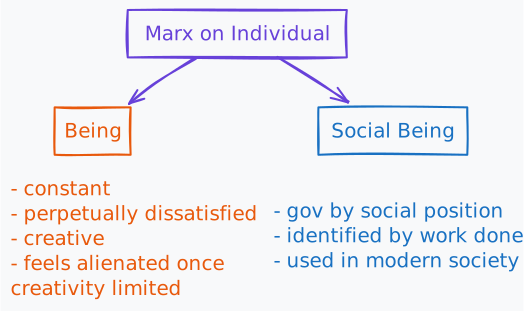
Predominant nature of social being different in different societies. eg. in capitalist, social being is selfish, but its cooperative in communist.
Alienation
Karl Marx
It was a history of increasing control of man over nature, at the same time it was history of increasing alienation of man.
- Marx: capitalism perverts inherent relation between labour and human nature
- man becomes slave of production, individuality lost
- man uses creativity to shape material world, but creativity objectified as he loses control over what he produces
2 Ways of Alienation
- given MoP it w/ time
- because material forces become stronger and control FoP
- eg. slaves in ancient MoP burdened w/ more work, less food
- in feudalism, taxes, hardships on serfs w/ time
- degree as MoP itself changes
- least in communism, max in capitalism (work becomes suffering)
Commodity Fetishism
- commodity product of labour of man
- but not for personal use; rather for exchange value
4 dimensions of alienation
lead to inversion of subject object relationship
- alienation from process of production
- alienation from product
- alienation from fellow workers
- alienation from oneself & one’s potential
Solution visualized in a state when production process was overhauled and relations of production modified. Eg. communism FoP collectively owned.
Criticism of theory of alienation
- Karl Popper: alienation can be breeding ground for creative ideas
- Durkheim: anomie & alienation can be corrected by existing structures
- Goldthrope: work is just a means to an end which is better living standard (workers more concerned about latter)
- CW Mills: not just working class suffering alienation, but white collared staff also. They assume false personality at work (fake smile, artificial politeness), as if personality also sold to employer
- Robert Blauner: Alienation depends on tech used at work. Different technologies different degree of alienation, social integration etc.
- Max Weber: over bureaucratization of society leads to alienation as man guided by fixed rules and creativity suffocated
Class & Society
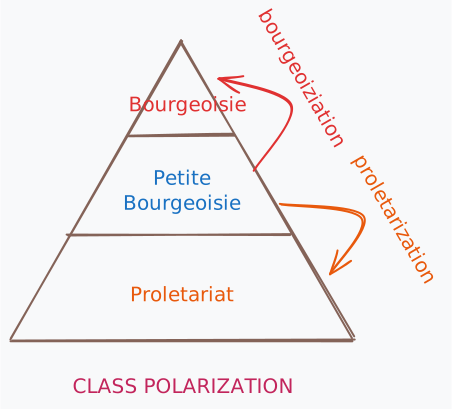
- class fundamental unit of organization
- society always divided into opposing classes
Karl Marx
Man is born in a society in which property relations have already been determined. Just as a man cannot chose who his father will be, he has no choice over his class as well.
- Class in Itself
- objective manifestation of class
- members not aware of being part of common stratum
- defined by positions in relationship of production
- Class for Itself
- CII becomes CFI when contradictions b/w consciousness of its members & reality of their situation ends
- workers aware of common conditions, their mission etc.
- start to see through condition of exploitation and can themselves realize unequal terms of production
Revolution will not come on its own. Its possible only if some mature conditions exist. These conditions include - critical mass of workers having consciousness, network of communication, clear perception of common enemy, appropriate organization, leadership etc.
Workers will take over State, abolish pvt property. Then renounce their rule state of communism. No class no class struggle.
Criticism of Class Struggle Theory
- futuristic conceptions failed to take shape even 130 years after demise. Industrial capitalism has only grown stronger, socialist experiments failed.
- Frank Parkin: classes exist even in socialist societies
- In Europe, workers themselves have become affluent and have stake in capitalist economy.
- Weber: stratification not just economic, but other factors too
- Lenski: even breakdown of capitalism not lead to socialism, as other MoP may emerge
- Dahrendorf: manual working class has become increasingly heterogeneous can’t revolt
Karl Marx
Capitalism sows its own seeds of destruction.
- capitalism inherently unstable because its based on contradictions & exploitation
- class polarization
- only large companies survive, wealth concentrated